Portfolio
Project - MTP Academy Sales Page
The Project Overview
Client
Mental Training Plan – a sports psychology coaching company that helps athletes and teams improve confidence, focus and performance under pressure.
Product
MTP Academy – an online mental training curriculum designed for high school and college sports coaches, programmes and athletes. The platform provides structured lessons, tools and resources to help athletes build confidence and perform well under pressure. The product is sold as a subscription.
Goal
Convert warm traffic into MTP Academy subscribers.
Funnel
Traffic arrives on the page after the founder delivers in-person presentations to sports teams and coaches. At the end of the presentation, attendees scan a QR code directing them to the sales page.
Because the audience has already been introduced to the concept of mental performance training, the copy emphasises ease of implementation and practical benefits for coaches and athletes.
Scope
Write a full long-form sales page presenting the problem of poor mental performance under pressure, introducing the MTP Academy curriculum, and selling the subscription offer.
See Sales Page
To see the sales page, click below.
Overview of My Approach
Step 1 – Customer Avatar Research
Before writing the sales page, I researched the target customer to understand their motivations, frustrations and decision-making process.
The goal of this research was to identify:
• The core problem coaches and athletes experience when trying to improve mental performance
• The emotional drivers behind their desire to perform well under pressure
• The language and phrases used when discussing confidence, focus and performance
• The barriers and objections that might prevent them from adopting a mental training programme
• The outcomes they want most, such as confident performance in high-pressure situations
This research helped shape the messaging throughout the sales page, ensuring the copy addressed the audience’s real frustrations while positioning MTP Academy as a practical and easy-to-implement solution.
Step 2 – Product Research
After researching the customer, I analysed the MTP Academy product to understand its core benefits and positioning.
This involved breaking down the product’s features and identifying the practical and emotional benefits they deliver to coaches and athletes.
Key areas of focus included:
• The primary outcome the product promises (improved confidence and focus under pressure)
• The practical tools and resources included in the curriculum
• How the programme helps coaches implement mental training without needing expertise in sports psychology
• The key claims that could be made about the product’s impact on performance
• How MTP Academy differs from traditional sports psychology coaching or mental training resources
This research helped identify the most compelling elements of the product and informed the messaging used throughout the sales page.
Step 3 – Client Credibility Research
To strengthen the persuasive power of the sales page, I researched the founder’s experience, credentials and track record in the sports performance industry.
The goal of this research was to identify credible proof points that would help overcome scepticism and build trust with coaches and athletes.
Areas of focus included:
• The founder’s professional experience and career progression in sports performance coaching
• Evidence of real-world results or case studies from athletes and teams
• Industry recognition, partnerships or media exposure that demonstrate authority
• The research, testing and development behind the MTP Academy curriculum
• Specific facts or numbers that could make credibility claims more concrete and believable
This research helped identify the strongest credibility elements to support the product’s claims and reassure prospective buyers that the programme is based on real experience and proven methods.
Step 4 – Competitor Research
I also reviewed competing mental performance offers and their marketing to understand how MTP Academy compares within the market.
The goal of this research was to identify opportunities to strengthen the sales argument and position the offer more clearly.
Areas of focus included:
• The features and benefits competitors emphasised in their products
• The claims, promises and proof elements used in their sales messaging
• Any gaps or weaknesses in their copy, such as vague benefits, weak proof or poor emotional connection
• How MTP Academy could be positioned more effectively based on ease of use, practicality and relevance for coaches and athletes
• Which themes, angles and promises seemed to appear repeatedly across the market
This research helped me identify where the offer could stand apart and how the sales page could present MTP Academy as a more practical and credible solution.
Step 5 – Identifying the Unique Mechanism
After researching the audience, product and market, the next step was identifying the core mechanism behind the product’s promise.
In direct response marketing, the mechanism explains why the solution works and helps differentiate the offer from competing alternatives.
The goal of this step was to identify:
• The specific process or system that allows athletes to improve confidence and focus under pressure
• How this approach differs from traditional mental training methods
• Why this system can produce results for coaches and athletes who may have struggled with other approaches
Clarifying this mechanism helped shape the central sales argument and allowed the copy to present MTP Academy as a structured and practical method for developing mental performance.
Step 6 – Sequencing the Core Beliefs
Before outlining the sales page, I mapped out the sequence of beliefs the reader would need to accept before purchasing.
Rather than presenting information randomly, the copy was structured to guide the reader through a logical progression of ideas.
This involved identifying:
• The problem the audience recognises and cares about
• Why the problem persists despite current solutions
• The mechanism behind the new solution
• Why the approach is credible and trustworthy
• The benefits and outcomes the product provides
• Why the offer represents a valuable and low-risk decision
By organising the message around these beliefs, the sales page builds persuasion gradually, making the final buying decision feel logical and justified.
Step 7 – Translating Features into Meaningful Benefits
Next, I reviewed the product’s features and translated them into benefits that would resonate with the target audience identified in the avatar research.
Rather than simply listing what the programme includes, the goal was to show how each element helps coaches and athletes solve the problems they care about most.
This involved identifying:
• The practical advantages each feature provides
• The performance improvements athletes and coaches are seeking
• The emotional outcomes, such as increased confidence and reduced pressure during competition
By connecting the product’s features to the audience’s motivations and frustrations, the copy emphasises the real-world value of the programme rather than just describing what it contains.
Step 8 – Structuring and Drafting the Sales Page
Once the research and messaging strategy were defined, the next step was structuring the sales page and drafting the copy.
The page was organised into key sections designed to guide the reader through the sequence of beliefs identified earlier.
These sections included:
• The opening hook, introducing the problem and capturing attention
• Expanding on the challenges athletes and coaches face under pressure
• Introducing the mechanism behind the solution
• Presenting the MTP Academy programme and its benefits
• Establishing credibility and trust
• Explaining the offer and subscription details
• Closing with a clear call to action
By structuring the page this way, the copy gradually builds interest, trust and desire before asking the reader to make a purchasing decision.
Step 9 – Editing and Refinement
After drafting the sales page, I reviewed the copy to improve clarity, persuasion and readability.
This editing stage focused on strengthening the overall sales argument while making the page easier and more engaging to read.
Areas of focus included:
• Ensuring the headline, subheads and opening section captured attention and communicated the core promise
• Improving flow and momentum so each section naturally led into the next
• Emphasising key benefits and proof elements to reinforce the sales argument
• Simplifying language to keep the copy clear, conversational and easy to read
• Breaking up the text with formatting such as subheads, bolded phrases and shorter paragraphs to improve scanability
• Checking that the copy maintained focus on the reader’s problems, desires and motivations
This final editing pass helped ensure the message remained persuasive, clear and engaging from the opening headline through to the call to action.
Breakdown of Step 1 - Target Avatar Research
Before writing the sales page, I researched the target audience to understand the challenges and motivations of coaches and athletes interested in improving mental performance.
The goal was to identify the emotional drivers and practical frustrations influencing their decision to adopt a mental training programme. Here’s what I found:
Core Insight
The central insight from the research was that coaches are not simply looking for “mental training.”
They want a system they can trust under pressure—one that ensures performance, culture and standards do not collapse in the moments that decide seasons.
The dominant desire of this audience is confidence that their programme will hold together when stakes are highest.
The Five Core Fears
The research revealed five major fears influencing how coaches evaluate solutions:
1. Performance Collapse in Big Moments
Coaches fear their athletes will tighten up under pressure, make mistakes and fail to close important games—reflecting poorly on the programme and the coach’s leadership.
2. Culture Drift
Over time, standards can erode as entitlement grows and accountability weakens, causing the programme’s identity to deteriorate.
3. Mental Training That Doesn’t Stick
Many coaches have tried mindset training before but saw little lasting impact because the concepts were too abstract or difficult to implement consistently.
4. Reputation Risk
Decisions made under pressure are often scrutinised by parents, administrators and stakeholders. Coaches fear being perceived as incompetent, biased or unprepared.
5. Moral Responsibility Toward Athletes
Some coaches worry about whether they are truly helping athletes grow—not just as competitors but as individuals beyond sport.
Key Pain Scenarios
Several recurring scenarios emerged that illustrate how these fears show up in day-to-day coaching:
• Teams performing well in practice but breaking down late in games
• Athletes entering negative mental spirals after a single mistake
• Mental training discussions occurring without consistent implementation
• Success creating additional pressure that destabilises culture
• Coaches struggling to maintain standards as programmes grow
These situations create frustration because talent and preparation often exist, but mental performance breaks down at decisive moments.
Key Barriers to Adoption
The research also revealed several factors that make coaches hesitant to adopt mental training programmes:
• Fear of reputational risk if the programme fails
• Limited time to implement additional training systems
• Uncertainty about how to introduce mental training in a structured way
• Dependence on athlete and staff buy-in for successful implementation
This highlighted the importance of presenting the solution as practical, structured and easy to integrate into existing training routines.
What Coaches Actually Want
Despite these challenges, the research revealed a clear picture of what coaches are seeking.
They want:
• Athletes who remain composed and focused under pressure
• A repeatable system that builds mental habits over time
• Alignment between coaches, athletes and programme culture
• Leadership and accountability that sustain standards across seasons
• Skills that help athletes succeed both in sport and beyond it
Ultimately, coaches want confidence that their programme will remain strong and reliable in high-stakes moments.
Strategic Implication for the Sales Page
These insights shaped the messaging throughout the sales page.
Rather than presenting the programme as generic mental coaching, the copy emphasised:
• Durability under pressure
• A structured system coaches can implement consistently
• The ability to create lasting cultural standards and mental habits
Positioning the offer this way directly addressed the audience’s deepest concern: whether the programme will hold together when it matters most.
Breakdown of Step 2 - Product Research
After researching the target audience, I analysed the tools and resources inside MTP Academy to understand what the product was really helping athletes and coaches achieve.
Rather than stopping at features, I translated each tool into the practical and emotional outcomes it created for the audience.
This involved reviewing the Academy’s core resources, including goal setting, deliberate practice, visualisation, pre-practice routines, tension control, confidence tools and mindset training, then identifying the specific results each one could help produce in real sporting situations.
Core Product Insight
The main conclusion from this research was that MTP Academy is not simply a collection of mental training tools.
It is a structured system for helping athletes perform more reliably under pressure.
Across the product, the strongest benefits repeatedly pointed to the same core outcomes:
staying calm in high-pressure moments
recovering faster after mistakes
improving focus and emotional control
building confidence from preparation rather than hype
making mental training practical and repeatable rather than vague
This made the product feel more like a performance system than a library of mindset advice.
Most Important Benefit Themes
After reviewing the product through the lens of the target audience’s fears and desires, I identified several key benefit themes that mattered most.
1. Performance Holds Up Under Pressure
Many of the tools ultimately helped athletes stay composed when the stakes were highest.
This was important because the audience’s biggest fear was not lack of effort, but breakdown in decisive moments.
2. Mental Skills Become Repeatable
The product did not just promise inspiration or motivation. It offered routines, systems and repeated behaviours that could actually stick.
This directly addressed the fear that mental training would be too generic or fail to transfer into competition.
3. Coaches Can Implement It Practically
A major strength of the product was that many tools were simple, structured and usable in real training environments.
That mattered because coaches were not looking for abstract psychology. They wanted something they could apply consistently with athletes.
4. Confidence Becomes Evidence-Based
Many tools built confidence through preparation, repetition and visible proof rather than empty encouragement.
This made the promise more believable and aligned with the audience’s desire for something durable under stress.
5. Athletes Recover Faster From Mistakes
A recurring product benefit was the ability to reset quickly, avoid spirals and return attention to the next action.
This was especially valuable because one of the biggest day-to-day pain points in the research was the “one mistake becomes many” problem.
Benefit Translation in Practice
To make the product more persuasive, I translated features into outcomes the audience would immediately care about.
For example:
Goal setting became clarity, direction, patience and confidence in the process
Deliberate practice became faster improvement and better transfer from practice to competition
Visualisation became calmness, familiarity and composure in big moments
Pre-practice routines became focus, presence and more useful training sessions
Freeing muscular tension became smoother movement, better timing and less tightening up under pressure
Success boards and confidence tools became proof-based belief and faster recovery after setbacks
This helped move the messaging away from “here’s what’s included” and towards “here’s what changes for the athlete or coach”.
Supporting Proof From Athlete Outcomes
The athlete examples strengthened the product research because they showed the tools producing visible changes in real contexts.
The strongest proof themes included:
rebuilding confidence quickly after poor performances
reducing self-talk driven tension and anxiety
improving reset ability after mistakes
helping athletes separate identity from results
turning mental skills into part of how they operate, not just something they try occasionally
These examples helped support the positioning of the Academy as a practical and credible performance system rather than a motivational add-on.
Strategic Implication for the Sales Page
This research shaped the way I presented the product in the copy.
Instead of describing MTP Academy as a set of mindset resources, I framed it as a structured solution for helping coaches and athletes build confidence, focus and resilience that hold up in competition.
That was important because it connected the product directly to the audience’s dominant desire: trust that performance and culture will not fall apart under pressure.
Breakdown of Client Credibility Research
After analysing the audience and product, the next step was identifying the strongest credibility elements that could support the sales argument.
Because mental performance programmes often face scepticism, the goal was to gather evidence showing that the system was proven, practical and already producing results for real athletes and teams.
This research revealed four main types of credibility.
1. Outcome Credibility (Real Performance Results)
The strongest proof came from measurable improvements in team performance and athlete outcomes.
For example:
• Westfield High School football improved from a 33% win rate to 71% after mental training became part of the programme. During that period the team won nine sectional championships, five regional championships and a state title.
• South Ripley High School transformed from an average programme to a 19–0 season, #1 state ranking and sectional championship after committing to structured mental training.
• Individual athlete improvements included measurable performance changes such as a player improving from 55% to 81% free throw accuracy after implementing visualisation techniques.
These examples provided clear before-and-after outcomes that made the benefits of mental training more concrete.
2. Mechanism Credibility (Why the System Works)
The research also revealed that MTP Academy provides specific tools and repeatable routines, rather than abstract motivational advice.
Examples include:
• Visualisation routines used before pressure situations
• “Go-to statements” that interrupt negative self-talk
• Breathing protocols that regulate physiological stress responses
• Scenario-based pressure drills to simulate competition environments
One core tool, the Focus Cycle, explains how pressure disrupts performance by shifting the brain into a fear state and provides a structured sequence for regaining control.
The sequence works by guiding athletes through a repeatable process:
Regulate the body through breathing
Reinforce confidence through self-talk
Refocus attention on controllable actions
Execute the next play or task
This helped demonstrate that the programme was built around a clear cause-and-effect performance model rather than vague mindset advice.
3. Adoption Credibility (Evidence the System Actually Sticks)
Another important credibility factor was how consistently the system was implemented by teams.
Several programmes integrated mental training directly into their weekly schedule.
For example:
• Some teams ran dedicated mental training sessions every week.
• Coaches incorporated shared language and “go-to statements” into practice environments.
• Players began reinforcing the concepts with each other during competition.
In some cases, the programme became embedded deeply enough that athletes themselves began leading sessions for younger teammates.
This demonstrated that the system was practical enough to implement and durable enough to become part of team culture.
4. Authority Credibility (Founder Expertise)
The credibility of the system was also strengthened by the founder’s background.
Ben Carnes has more than 15 years of experience as a coach and educator, with a Master’s degree in Education focused on coaching and athletic leadership.
His work began after witnessing a highly talented team collapse in a championship game due to pressure.
That experience led him to study sports psychology, neuroscience and performance coaching, eventually developing the Mental Training Plan system to help athletes maintain composure in high-stakes moments.
Since then, the system has been used by:
• youth athletes
• high school and collegiate programmes
• professional athletes
• coaches across more than a dozen states
Several Division I programmes have also adopted elements of the system.
Strategic Implication for the Sales Page
This credibility research shaped how the programme was presented in the copy.
Rather than relying on motivational claims, the sales page emphasised:
• measurable performance outcomes
• practical mental training tools
• real-world implementation by coaches
• the founder’s experience developing the system
Together, these elements helped answer the central sceptical question prospects often have:
“Why should I believe this will actually work for my athletes?”
Breakdown of Competitor Research
To understand how MTP Academy could be positioned more strongly, I reviewed competing mental performance offers and analysed the proof, benefits and emotional language used on their sales pages.
The goal of this research was to identify where the market felt vague, generic or unconvincing — and where the MTP Academy page could create sharper differentiation.
Key Competitive Gaps
1. Weak Proof on Core Offer Pages
Several competitors presented themselves professionally and showed strong credentials, but their sales pages were often light on concrete proof.
Common gaps included:
few named case studies
limited before-and-after stories
very little specific evidence showing what changed for athletes
This created an opportunity to make the MTP Academy page feel more credible by using clearer outcomes, real examples and more observable behaviour changes.
2. Broad Benefits Instead of Specific Performance Moments
Many competitor pages described benefits in broad category language such as “build confidence”, “overcome self-doubt” or “improve focus”.
What was often missing was specific, high-pressure sporting context.
For example, very few pages translated mental performance into moments like:
recovering after one mistake
wanting the ball in key moments
avoiding panic when the game tightens
stopping the body from tightening under pressure
This created an opportunity to make the MTP Academy sales page feel more vivid and believable by grounding benefits in real game-day situations.
3. Limited Emotional Bonding With the Prospect
Competitors often bonded through authority and expertise, but less through the messy inner experience of pressure.
What was frequently missing included:
the athlete’s internal dialogue
physical symptoms of stress
the real-life pressures around selection, scrutiny and performance
This suggested the market was underusing emotionally specific language, especially around what it feels like when confidence slips or performance starts to unravel.
Strategic Implication for the Sales Page
This research shaped the positioning of the MTP Academy page in three important ways.
First, I made the proof more concrete by emphasising real outcomes, behaviour changes and specific examples.
Second, I translated benefits into recognisable performance moments, rather than relying on generic terms like confidence or focus.
Third, I used more emotionally specific language to reflect the real pressure coaches and athletes experience, helping the page bond more directly with the reader.
This allowed the page to position MTP Academy not just as another mindset offer, but as a practical, credible system for handling pressure in moments that decide games and seasons.
Breakdown of Finding The Unique Mechanism
After analysing the audience, product and market, I looked for the core mechanism that explained why this programme works.
The strongest mechanism I identified was not simply “mindset training” or “confidence coaching”.
It was a more specific performance model:
Under pressure, athletes can enter a fear state that disrupts focus, increases physical tension and blocks access to their trained execution. MTP’s Focus Cycle is designed to help athletes switch from fear mode back into performance mode.
This was important because it gave the sales page a clear explanation for both:
why talented athletes still break down in big moments
why MTP Academy can help them recover control
Core Mechanism Insight
The key insight behind the mechanism is that pressure changes performance by changing the athlete’s state.
When athletes perceive threat, their attention shifts, their breathing changes, heart rate rises, muscles tighten, and their usual patterns of execution become disrupted.
Instead of performing automatically, they begin thinking about:
the score
previous mistakes
what other people think
the consequences of failure
This creates a breakdown in focus and execution, even when the athlete already has the skill.
That makes the problem feel less like a lack of character or ability, and more like a predictable pressure response.
Why the Mechanism Is Persuasive
This mechanism gave the sales page a stronger argument for three reasons.
1. It explains choking in a believable way
Rather than using vague phrases like “mental toughness” or “be more confident”, the mechanism gives a concrete reason why performance falls apart.
The athlete is not just “weak mentally”.
Their attention, physiology and self-talk have shifted into a state that interferes with execution.
2. It makes the solution feel teachable
Because the problem is framed as a state change, the solution can be framed as a repeatable process for regaining control.
That makes the programme feel more practical and coachable.
3. It differentiates the offer
Many competitors talk generally about confidence and mindset.
The Focus Cycle gave this sales page a more specific and logical explanation of what is happening in big moments and what to do about it.
The Mechanism in Action: The Focus Cycle
The strongest part of the mechanism was the sequence itself.
The Focus Cycle works as a practical operating system for regaining performance under pressure:
Control the body
Use breathing and muscular relaxation to reduce the fear response and physical tension.Control self-talk
Replace destructive inner dialogue with go-to statements built around effort, identity and earned confidence.Control focus
Redirect attention away from outcome, judgement and past mistakes towards what is controllable and matters now.Return to action
Execute the next play, shot or moment with greater clarity and composure.
This structure was especially valuable because it showed that MTP Academy was not promising one magic trick.
It was offering a stacked system.
Why This Was Commercially Useful
This mechanism helped solve one of the biggest objections in the market:
“Mental training sounds vague.”
The Focus Cycle made the offer easier to believe because it showed:
what goes wrong
why it goes wrong
how the athlete regains control
why that process can be repeated and trained
It also gave the copy stronger language for explaining pressure moments, including:
shaky hands
tight shoulders
racing thoughts
butterflies in the stomach
tunnel vision
negative self-talk
That made the page feel more specific and emotionally real.
Strategic Implication for the Sales Page
Identifying this mechanism changed how I framed the offer.
Instead of presenting MTP Academy as a broad mental performance programme, I positioned it as a system for helping athletes regain control when pressure flips them into fear mode.
That made the message sharper, more believable and more differentiated.
It also connected directly to the audience’s dominant fear from the avatar research:
that performance, confidence and culture will collapse in the moments that matter most.
Breakdown of Structuring the Sequence of Beliefs
After completing the research phase, the next step was determining the logical belief progression that the reader needed to move through before buying.
Rather than presenting the offer immediately, the page first needed to shift the reader’s understanding of why teams collapse under pressure.
The belief sequence used in the sales page follows this progression:
Coaches recognise the frustration of teams performing well in practice but collapsing in big moments.
The problem is not talent, effort or strategy.
Pressure breakdown is a predictable brain and body response.
Because it is a pattern, it can be trained.
The Focus Cycle provides a specific system for restoring performance under pressure.
The system has already produced results across multiple sports and teams.
It is simple to implement within existing training schedules.
Coaches can install the system in as little as fifteen minutes per week.
This sequence was designed to gradually replace the common belief that mental toughness is an inborn trait with the idea that it can be systematically trained.
Breakdown of Translating Features To Benefits
After identifying the core mechanism of the programme, the next step was translating the tools inside MTP Academy into benefits that would resonate with the target audience.
The programme contains many practical tools, including:
goal setting frameworks
deliberate practice structures
visualisation routines
pre-practice focus routines
muscular relaxation techniques
success boards
optimistic perfection training
However, simply listing tools would not persuade a prospect.
To make the benefits clearer and more compelling, I used an approach inspired by Clayton Makepeace’s feature-to-benefit analysis.
For each tool in the programme, I analysed:
the feature itself
the functional benefit it provides
why that benefit matters psychologically to the athlete
specific situations where the benefit becomes valuable
This process helped translate technical tools into real performance outcomes the audience cares about.
Example: Visualisation
Feature
A structured visualisation routine that athletes use before and during competition.
Functional benefit
The athlete mentally rehearses key situations, making them feel familiar and reducing hesitation during competition.
Why it matters psychologically
Athletes often experience anxiety in unfamiliar or high-stakes situations. By mentally experiencing those moments in advance, the athlete feels calmer and more confident when they actually occur.
Where it matters most
taking a decisive penalty or free throw
stepping into a high-pressure match or showcase
returning from a mistake without panicking
Instead of feeling overwhelmed by the moment, the athlete feels as though they have already been there before.
Example: Pre-Practice Routine
Feature
A structured routine athletes use before training sessions.
Functional benefit
It helps athletes enter practice with focus and intention rather than drifting through drills.
Why it matters psychologically
Many athletes struggle with inconsistent focus during training, which reduces the transfer of practice improvements into real competition.
Where it matters most
mid-season training when motivation drops
chaotic team practices with multiple drills
preparation sessions before an important game
The routine ensures that practice becomes deliberate skill development rather than time spent going through the motions.
Example: Muscular Relaxation Techniques
Feature
A tension-release protocol that helps athletes control physical stress responses.
Functional benefit
Athletes can release tightness and regain fluid movement when pressure increases.
Why it matters psychologically
Many athletes experience physical symptoms under pressure, such as tight shoulders, shaky hands or rushed movements.
Where it matters most
taking a golf swing late in a round
shooting free throws late in a game
performing a serve or penalty under pressure
By releasing tension quickly, the athlete can perform closer to their natural ability.
Strategic Benefit Pattern
While analysing the tools, a clear pattern emerged.
Almost every tool in the programme helps athletes solve one of three problems:
regaining control of their body under pressure
controlling their internal dialogue
focusing attention on the next action
This mirrors the structure of the Focus Cycle mechanism.
That alignment helped ensure the benefits on the sales page felt consistent and logical rather than random.
Why this process mattered for the sales page
This exercise generated a large pool of potential benefits, but more importantly it helped identify the most emotionally meaningful outcomes.
The benefits that resonated most strongly with the audience were those connected to high-pressure moments, such as:
recovering quickly after mistakes
staying composed when the game tightens
trusting preparation rather than overthinking
performing closer to one’s true ability in competition
These insights helped shape the benefit sections of the sales page so they reflected the real moments where athletes feel pressure and doubt.
Breakdown of Editing And Refinement
Here’s selected principles of how I edited this sales page:
Editing For Rhythm
To make the copy effortless to read so the reader keeps moving. Strong rhythm removes friction, varies pacing, and creates a natural flow that holds attention. When the writing feels smooth and easy, the reader is less likely to pause, skim, or drop off — increasing the chances they stay engaged and keep reading through to the point of action.
Editing For Forceful Verbs
To increase the impact and clarity of the copy by replacing weak, generic verbs with precise, vivid ones. Strong verbs carry more meaning on their own, removing the need for extra words and making the message feel sharper, faster, and more direct. This keeps the copy punchy, reduces drag, and makes each line hit with more force — helping the reader stay engaged and absorb the message with less effort.
Editing For A Colloquial Tone
To make the copy sound like a natural, human conversation so it feels easy to read, easy to trust, and easy to believe. Colloquial language removes stiffness and corporate distance, helping the message land more directly and feel more relatable. When the writing sounds like something the reader would actually say or hear, resistance drops, engagement rises, and the copy becomes more persuasive without feeling forced.
Editing For Word Pictures
To make the message instantly clear and emotionally engaging by turning abstract language into concrete, visual imagery the reader can picture. Strong word pictures help the reader see what’s being promised, making the benefits feel more real, specific, and believable. This reduces confusion, increases emotional impact, and helps the message stick — so the reader doesn’t just understand the claim, they experience it.
Editing For Positive Form
To make the message clearer and more direct by expressing ideas in a straightforward, affirmative way instead of through negatives. Positive phrasing reduces mental effort, removes indirect wording, and helps the reader grasp the message faster. This makes each line feel more confident, easier to process, and more impactful — keeping the reader engaged and moving forward.
Project - Golf Coach Accelerator (Long Form Sales Page, Facebook/Instagram Ad & Email Funnel)
This project was my own offer. The offer provides various ebooks, guides, checklists, toolstacks, audio/video trainings to help golf coaches grow their social media followings, build effective websites and save time using AI. The offer also includes a product or service page copy tune up, in which I’ll rewrite one of their website pages to land more students.
Below you'll see the copy and my breakdown of the long form sales page, Facebook/Instagram Ad and the Email funnel.
Long Form Sales Page
To see the live page, click the button below.
Breakdown of Long Form Sales Page
The Problem
There are thousands of golf coaches online, who are saturating YouTube and Instagram with content. Therefore, to grow online, golf coaches need to stand out to grow followings and get booked up. As part of the copy tune up, my intent was to find what makes each coach unique. You only have to visit Skillest to see the copy on each golf coaches page is similar.
The Audience
Golf coaches looking to boost their online presence (Social media, YouTube, paid ads etc). Particularly coaches who were selling digital programs, courses or ebooks.
Laying The Foundation With Avatar Research
As with any project, deep research on golf coaches allowed me to get inside their heads so I could speak to them effectively. This involved researching their:
Top 5 Google searches
Top 5 YouTube channels watched
Personality traits
Values
Interests
Fears
Complaints from existing solutions
Top 5 pain points
Bad decisions made
Criticism from others
Pre-existing worry
Biggest anxiety
Biggest embarrassment
What they feel guilty about
How they’d disappointed others
What happens if they ignore their problems
Top 5 challenges
Top 5 roadblocks
Lifestyle desire
Top 5 desires
What they’d want to escape to
Top 5 emotions
Top 5 beliefs
What makes them feel respected
What they want affinity to
Their expectations with my offer
Big result they’re looking for
Decision triggers
Objections
The Framework of The Sales Page
The framework for this long form sales page was a classic ‘Problem, Agitate, Solve’. In particular, the framework from the book “Copywriting Secrets” by Jim Edwards.
Use of Objections To Create Sub headlines
On a copywriting podcast, I heard a concept called “Storyboarding”. This copywriting concept from Agora Financial, involves using the main objections of a prospect as sub headings in a sales page. The aim is to stop the scroll and get prospects emotionally hooked into the sales page.
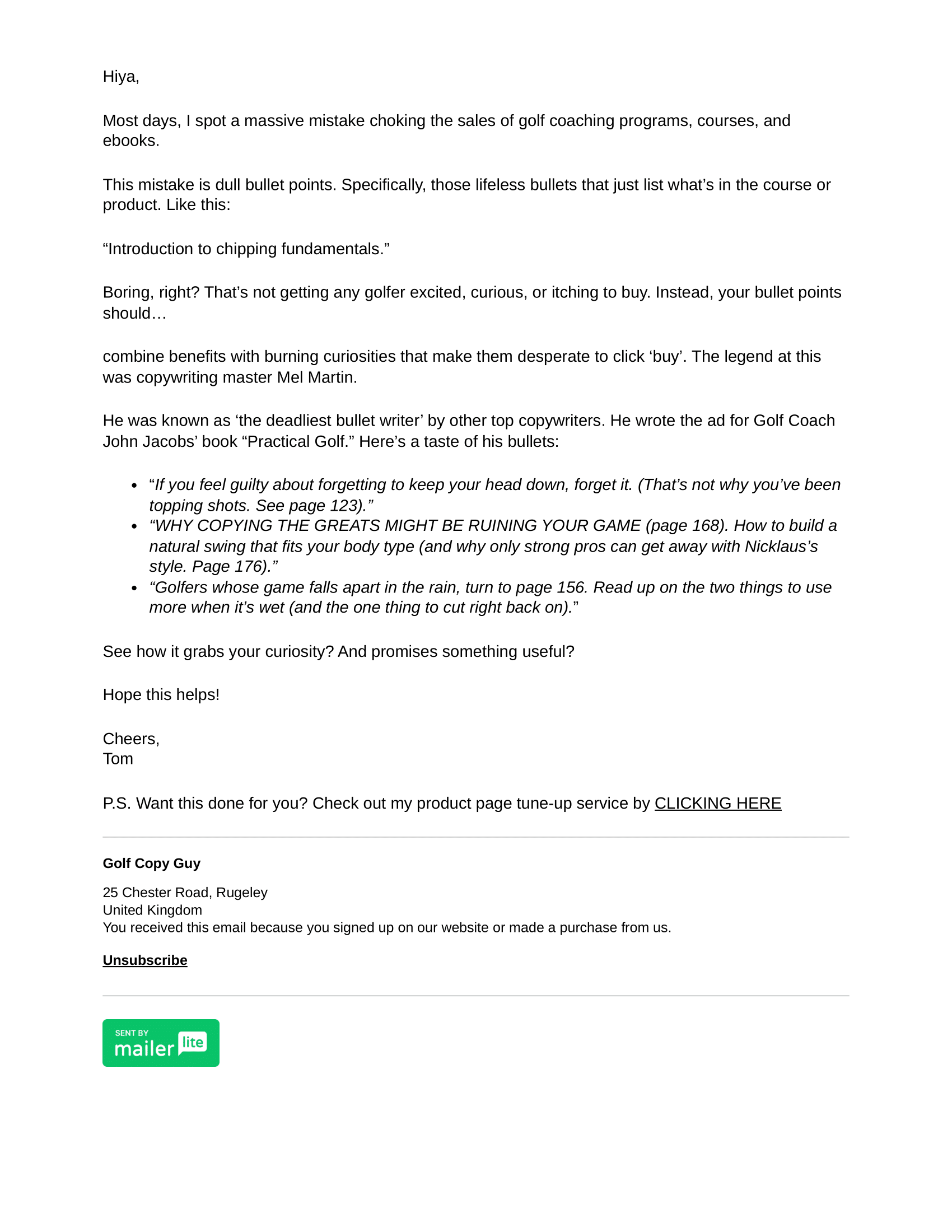
Use of Benefit + Curiosity To Write Persuasive Bullets
In my study of Copywriting greats, I came across Gary Bencivenga. His ultimate approach to persuasive bullet points was to combine benefits with curiosity. In order to play on the prospects greed for results, and curiosity to want to find out more by purchasing. For example:
“What to share (and what not to) if you want more clicks, DM’s and students.”
Use of A Strong Guarantee To Reduce Doubt
I wanted to give them maximum confidence this offer gets results. Which is why I said I’d give a full refund up to one year even if they were disappointed with only one aspect. I feel consumers don’t get excited by a standard 14 or 30 day money back guarantee.
Raise Perceived Value To Make It A No Brainer
I believe you must make the prospect genuinely believe the product is worth ten times the price they’re paying. This is done by applying realistic prices to each product, and brainstorming every possible benefit each product delivers to the prospects life. Specifically in line with what makes people buy, which are:
Make money
Save money
Save time
Improve their health
Gain respect
Escape mental pain
Avoid effort
Get more comfort
Gain praise
Feel more loved
Increase their popularity or social status
Create Rapport Through Empathy
The first paragraph of the sales page is the “Problem” section in which I’m relating to the prospect by reflecting on their daily struggles. This aims to build trust that I know exactly what they’re going through. Hence, they’ll trust I have the solution.
Result
I tested this offer initially with an ad spend on Facebook of £65. It made one sale at £79. The conversion rate for the sales page was 3.94%.
Reflection
I was happy with a 3.94% conversion rate to cold traffic. I genuinely believe the offer is packed with value, as you get around 50 ebooks, plus various checklists, toolstacks, guides, audio/video training. Not to mention the copy page tune up.
The one big area for improvement on this sales page was the authority. When I make an improved version of this sales page, I’ll delve into the proof of all the methods used in the ebooks.
Facebook/Instagram Ad Image & Text
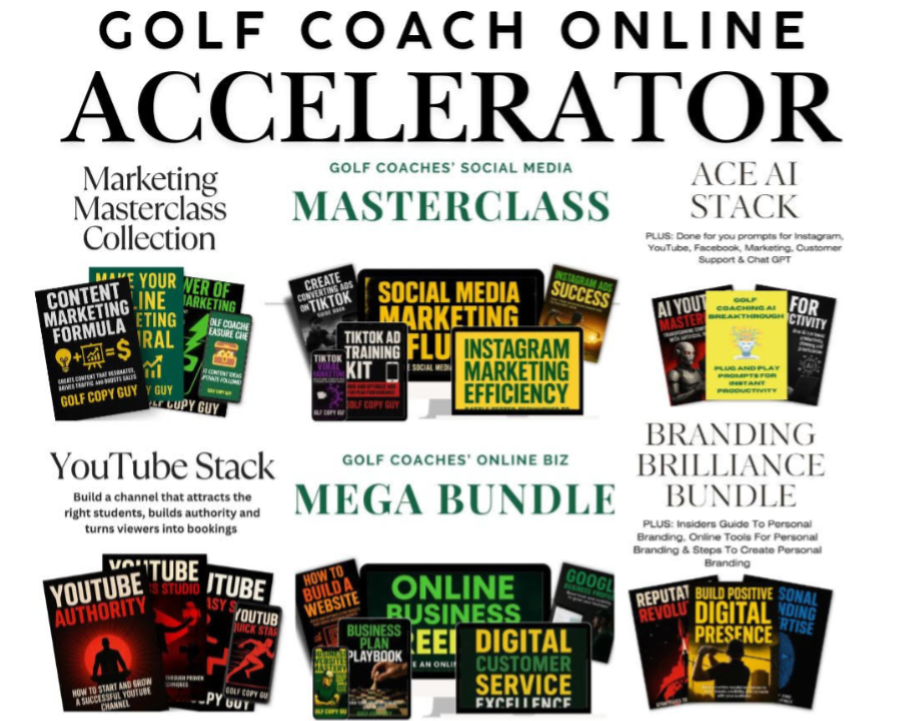
Ever wonder why some golf coaches blow up online, while others get left grinding for scraps?
It’s not luck.
It’s not posting every day ‘til your thumbs fall off.
It’s not some fancy editing app or algorithm luck either. Here’s what it is.
It’s tactics and strategies top online coaches don’t want you to know.
Like how to pick hashtags which get real engagement (so you don’t get lost in a sea of voices).
Or how to be 10X more productive whilst working less.
And how to follow up after a free swing review, so you stop getting ghosted. Even when the student said “That was amazing!”
These are just a few of the moves inside the Golf Coach Accelerator.
Which shows you how to:
✅ Grow your audience without burning out.
✅ Keep students coming back for more to cut the feast or famine cycle.
✅ Build a brand that makes you the obvious choice.
All without needing a tech degree.
Or an ad budget.
Or even a YouTube channel (yet).
Want in?
Click “learn more” if you wanna do it the smart way.
Copy Insights
Use of Curiosity To Hook The Reader
I like to create ‘open loops’ in the prospects mind to get them invested in reading all the copy. One way to do this is to use ‘not’ statements as you’ll see in the first 3 lines of the ad. The aim is to make the reader think “What is it then?” and read until they find out. The curiosity theme is then continued all the way through the copy as it doesn’t tell you exactly how the Golf Coach Accelerator works.
Destroying Objections To Create Belief
In my prospect research, I found 3 of the golf coaches' problems when trying to grow online is they weren’t tech savvy, didn’t have a big budget and some didn’t even have a YouTube channel. Which is why I’ve said you don’t need any of these to succeed. Thus creates belief and confidence in my offer.
Engaging Emotions Which Make People Buy
I believe people buy on emotions and justify on logic. Therefore, I’ll look for ways to engage my prospects emotionally. In this case, I’m using scarcity and a forbidden style approach by saying “It’s tactics and strategies top online coaches don’t want you to know”. Humans have a natural need to find things which are being kept from them. Plus, it raises it’s perceived value. It also touches on envy, as the prospect thinks what’s being kept from them is why others are ahead. All this makes it more tempting to buy.
Email Follow Up Funnel
Overview
I tested offering a lead magnet up front followed by this email flow to get prospects to buy the Golf Coach Accelerator. I tested it with a £25 Meta ad spend.
The Result
This flow sent 536 emails to 24 subscribers, resulting in:
2 sales
Overall open rate of 67.14%.
Click to open rate 4.79%
Clicked rate of 3.21%
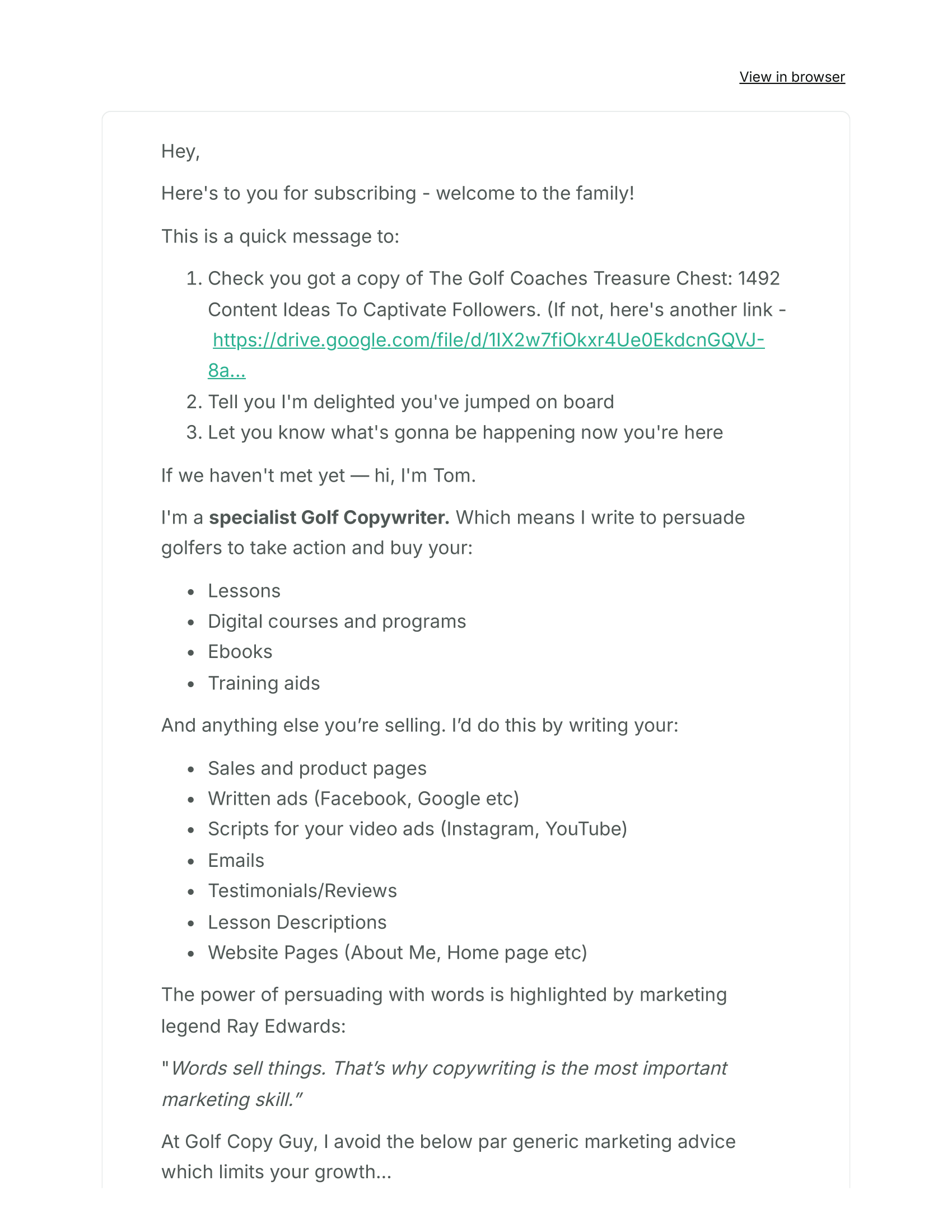
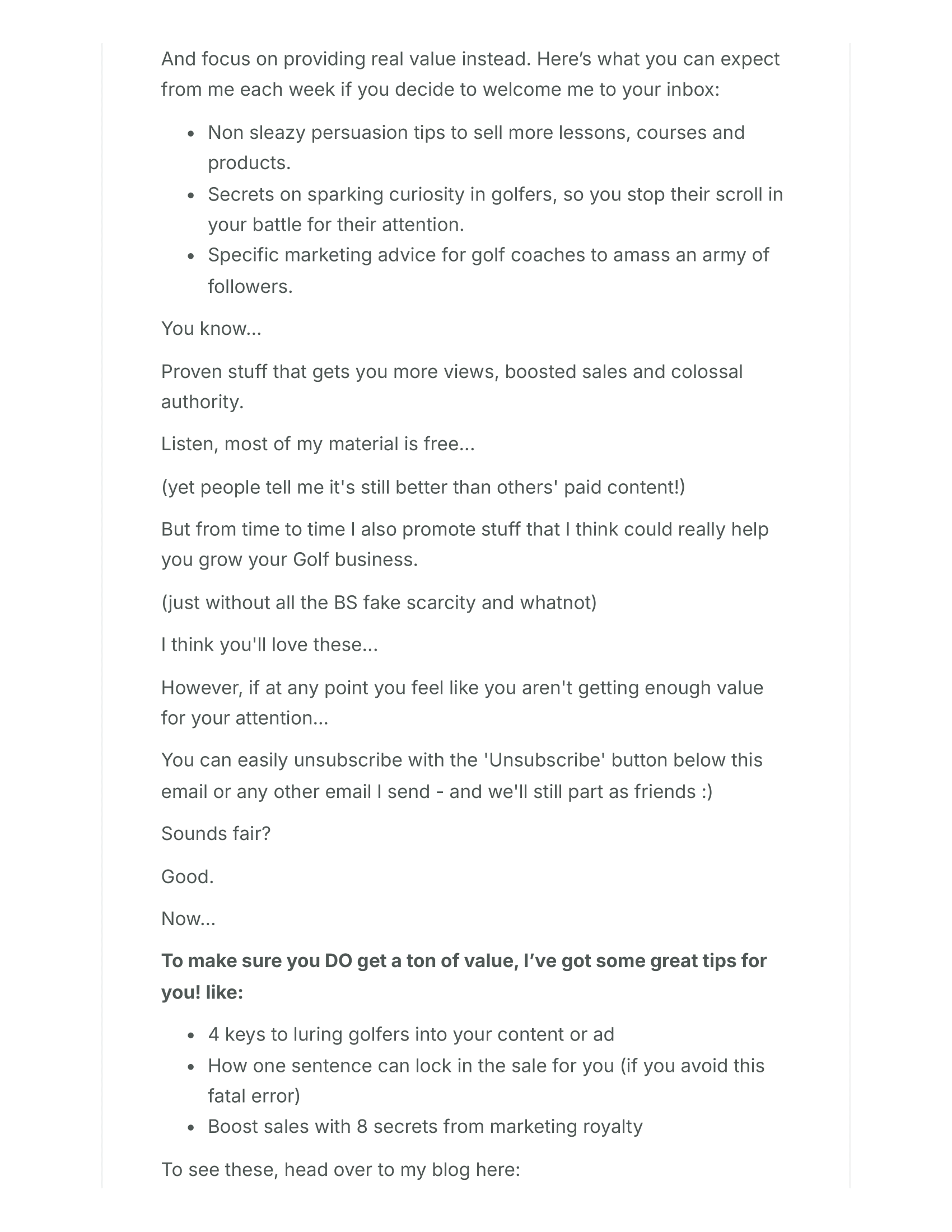
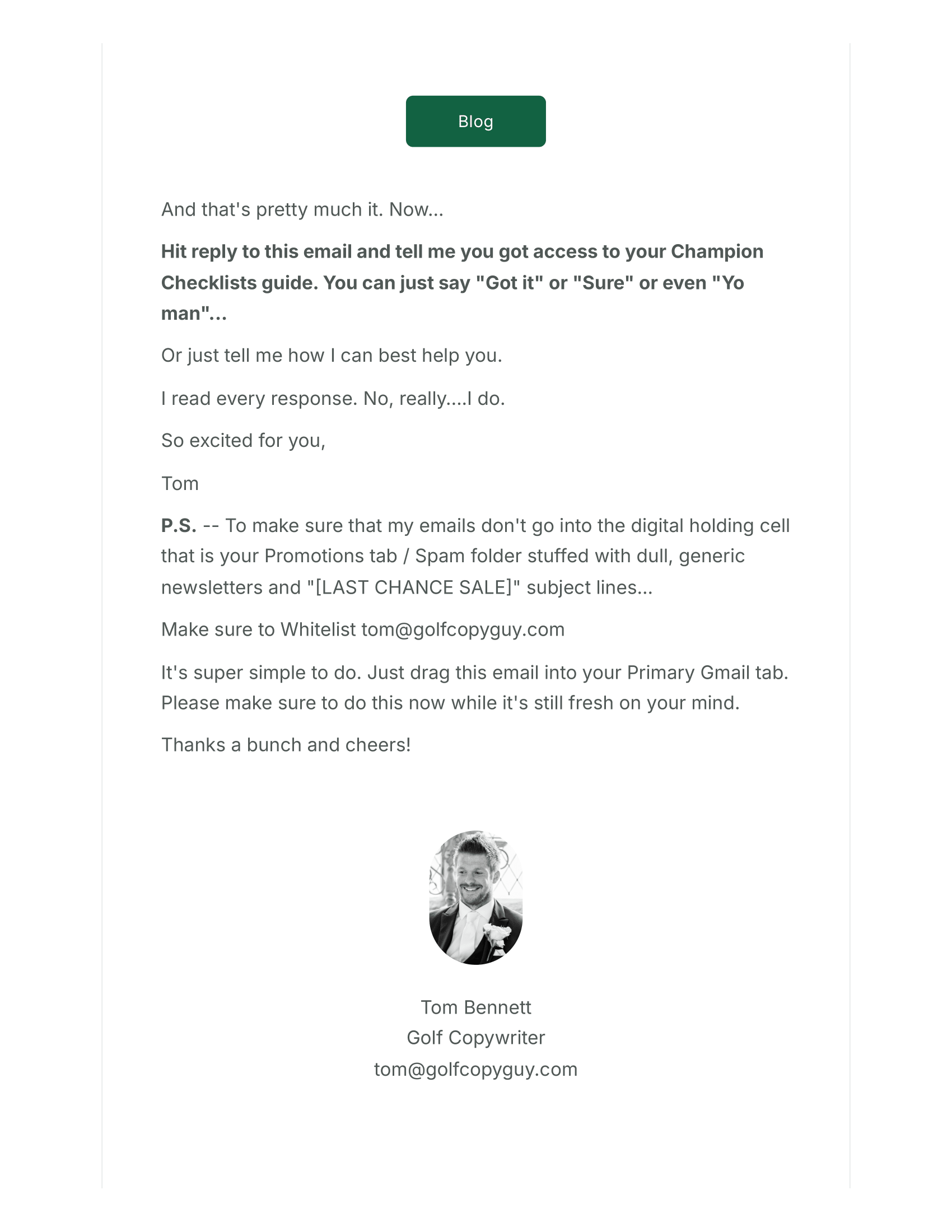
Email #1 - Welcome Email
The goal of this email is to:
Build rapport and trust instantly.
Outline exactly how I can help them.
Set expectations they’ll receive useful advice.
Whitelist me so my emails land in their inbox.
Encourage them to reply for better email deliverability.
Subject Line: Welcome! Here's what to look forward to...
Body:
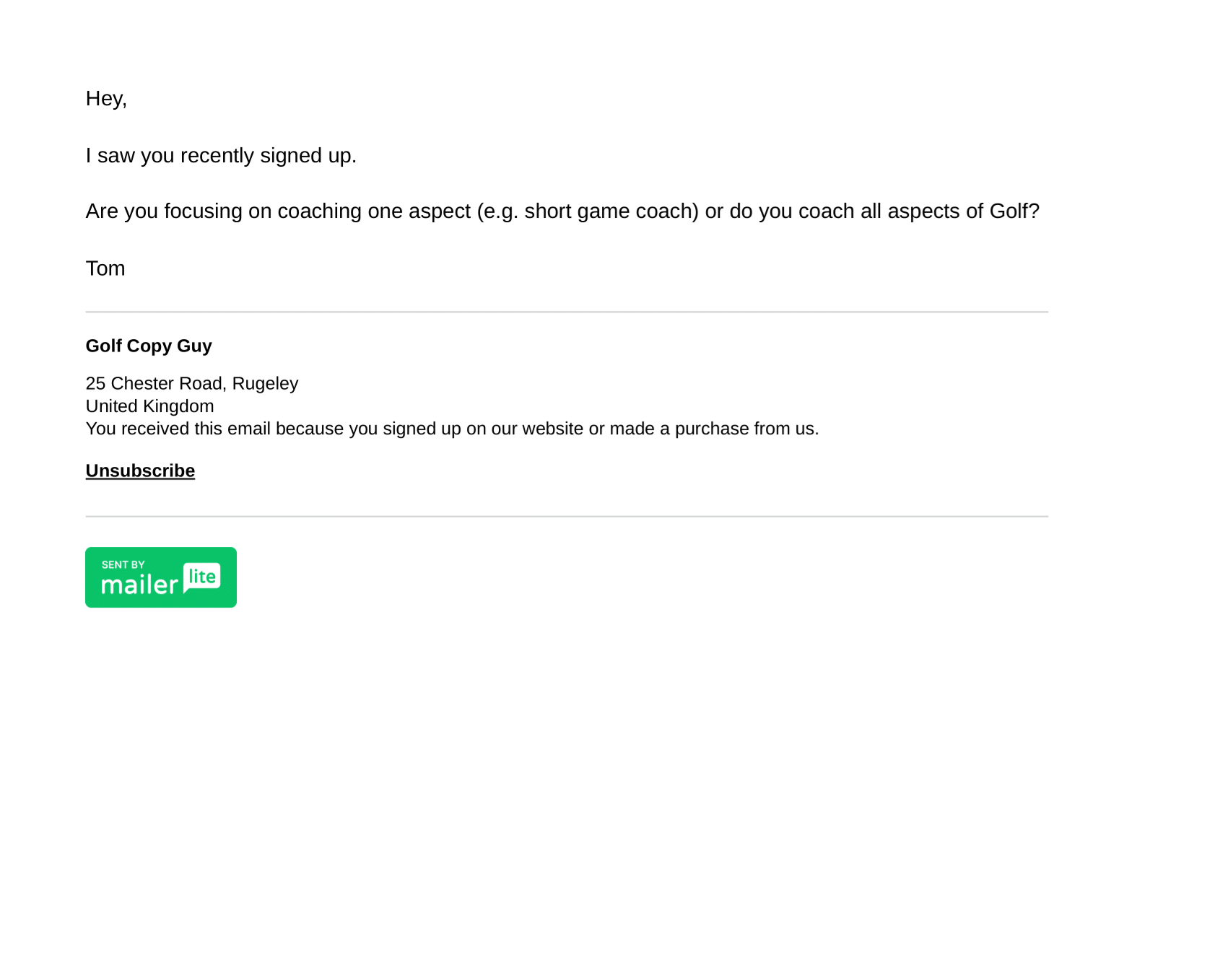
Email #2 - Conversation Starter
The goal of this email is to:
Increase prospect engagement.
Further help my email deliverability.
Open up opportunities to figure out what they want, qualify them, and allow you to point them to the right solution for their situation.
The key to this email is not a hard sell. It’s to simply start a conversation as if you were speaking to a friend. Which is why it’s informal, short and conversational.
Here's the email:
Subject Line: Tell me about you
Body:
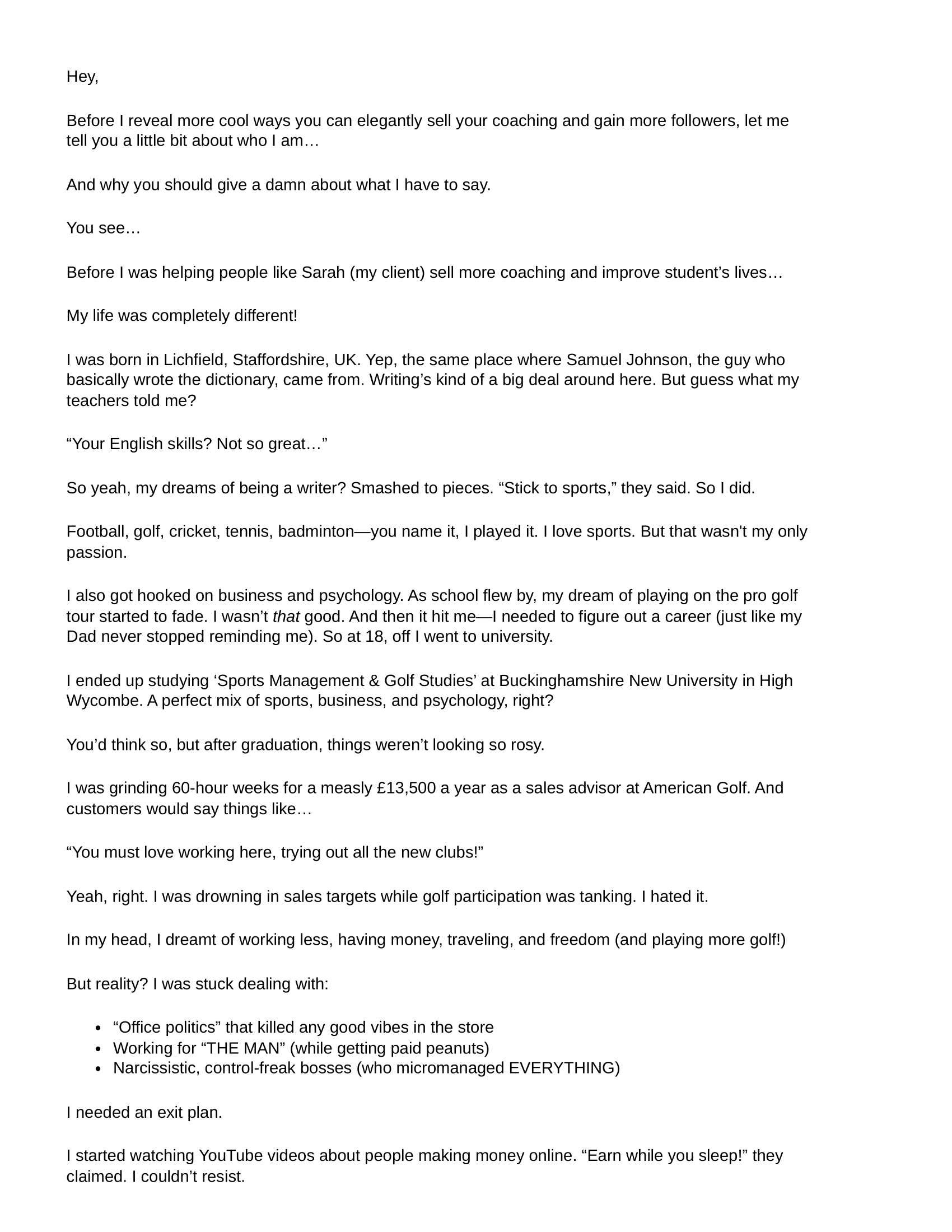
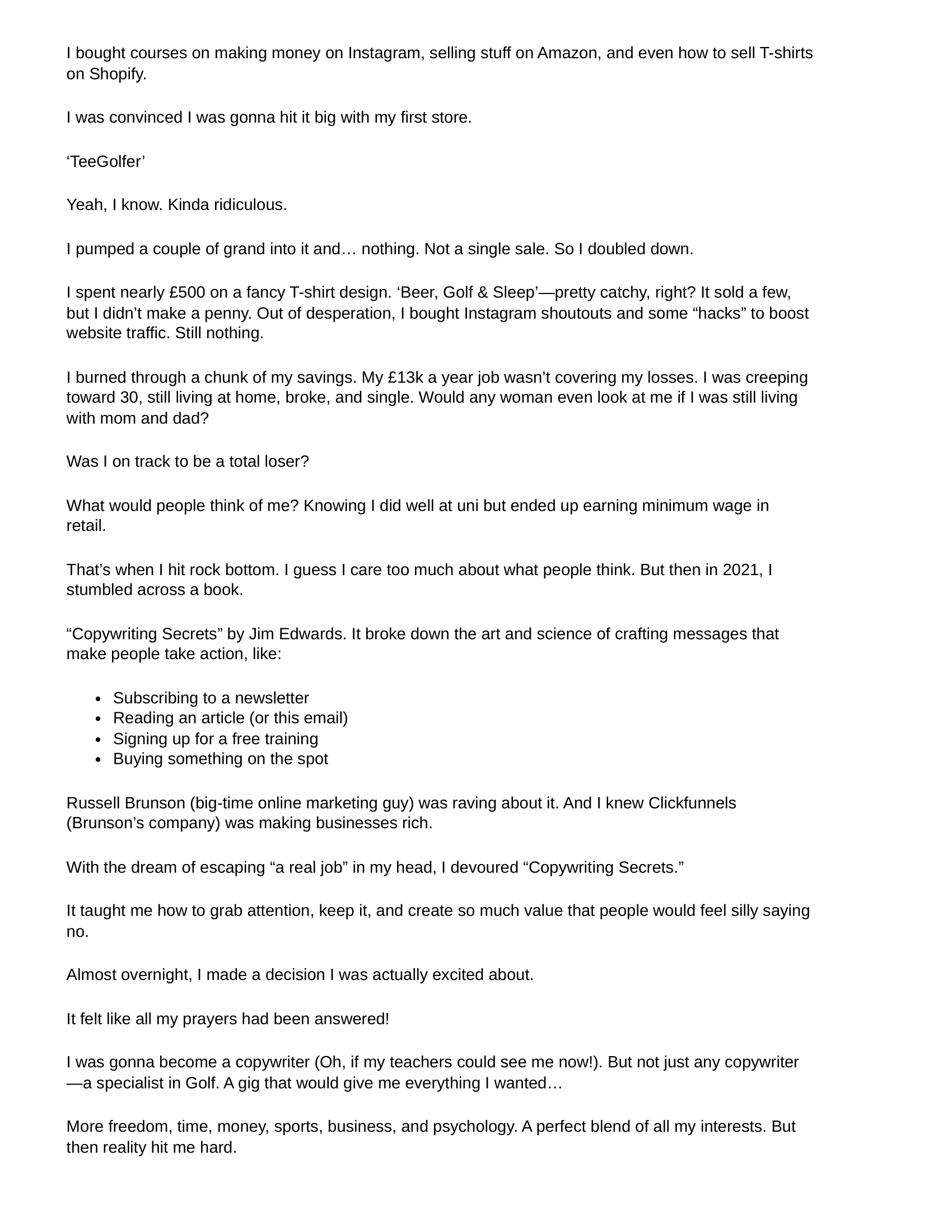
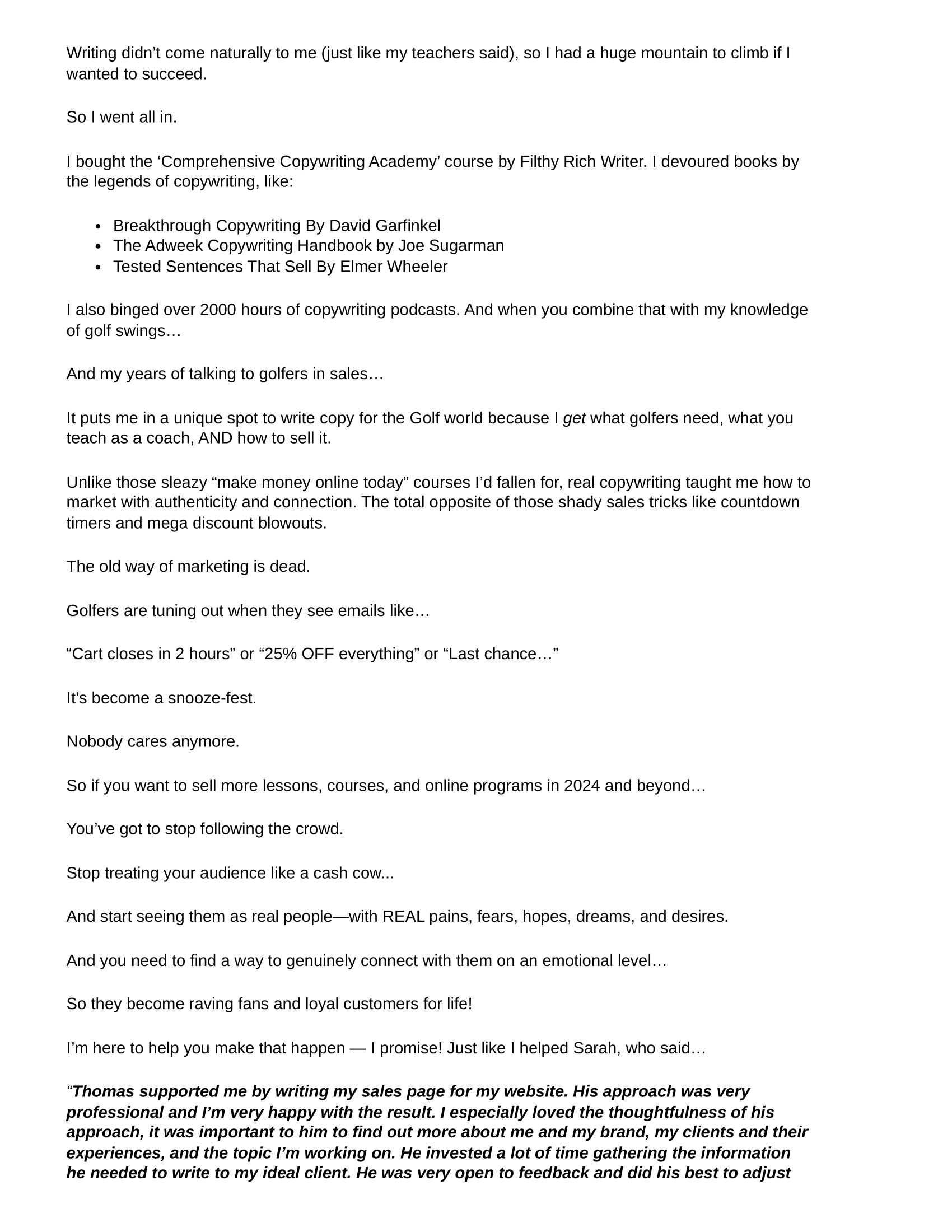
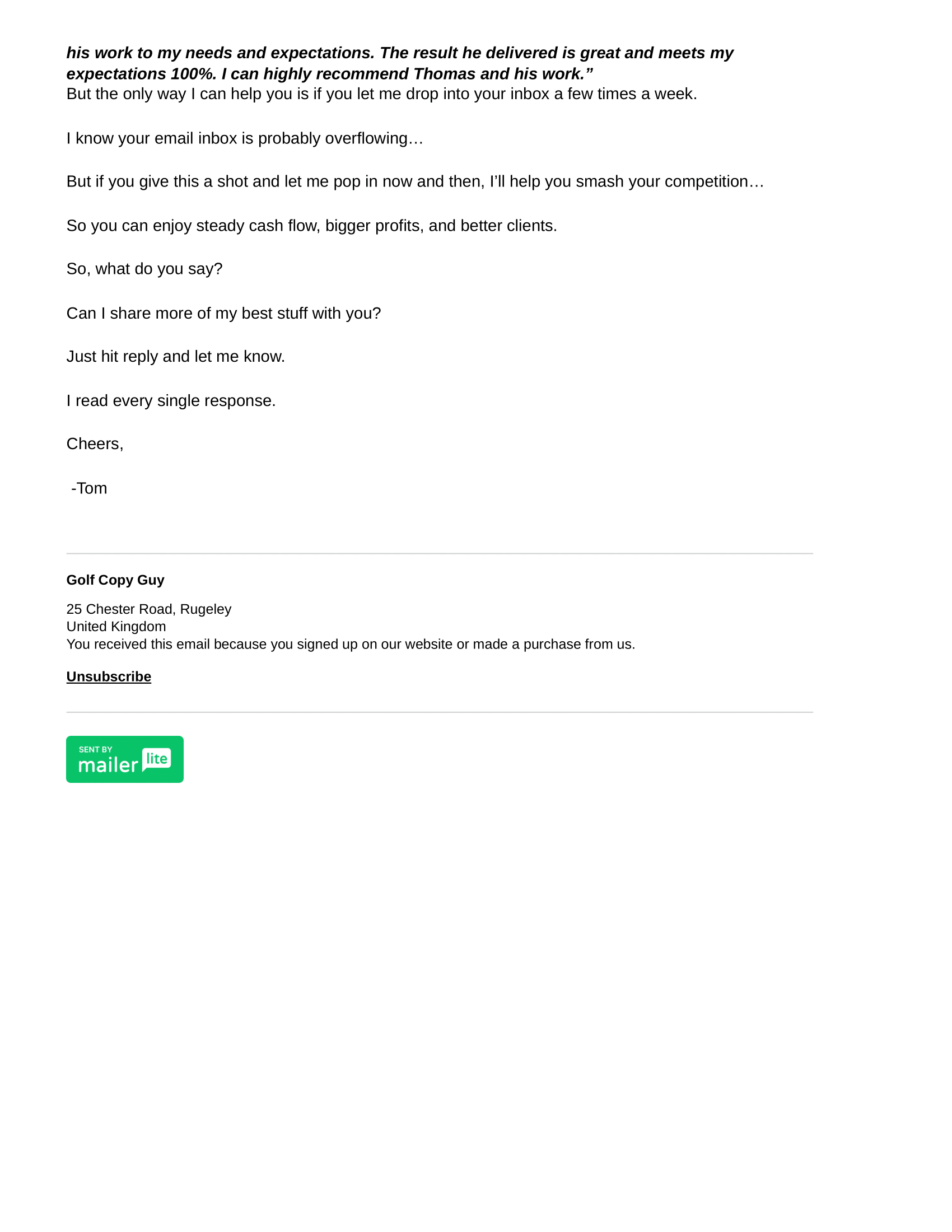
Email #3 - Origin Story
The goal of this email is to further build the ‘know, like and trust’ factor through storytelling. This email reveals challenges and vulnerabilities from the past which humanizes me and makes me relatable. I don’t believe in trying to sound perfect, because that’ll raise scepticism. There’s a real person here, not a faceless corporation. That’s what helps a deep connection with the prospect.
Here's the email:
Subject Line: Wanna sell in 2024? Ditch this
Body:
Email #4 - Credo
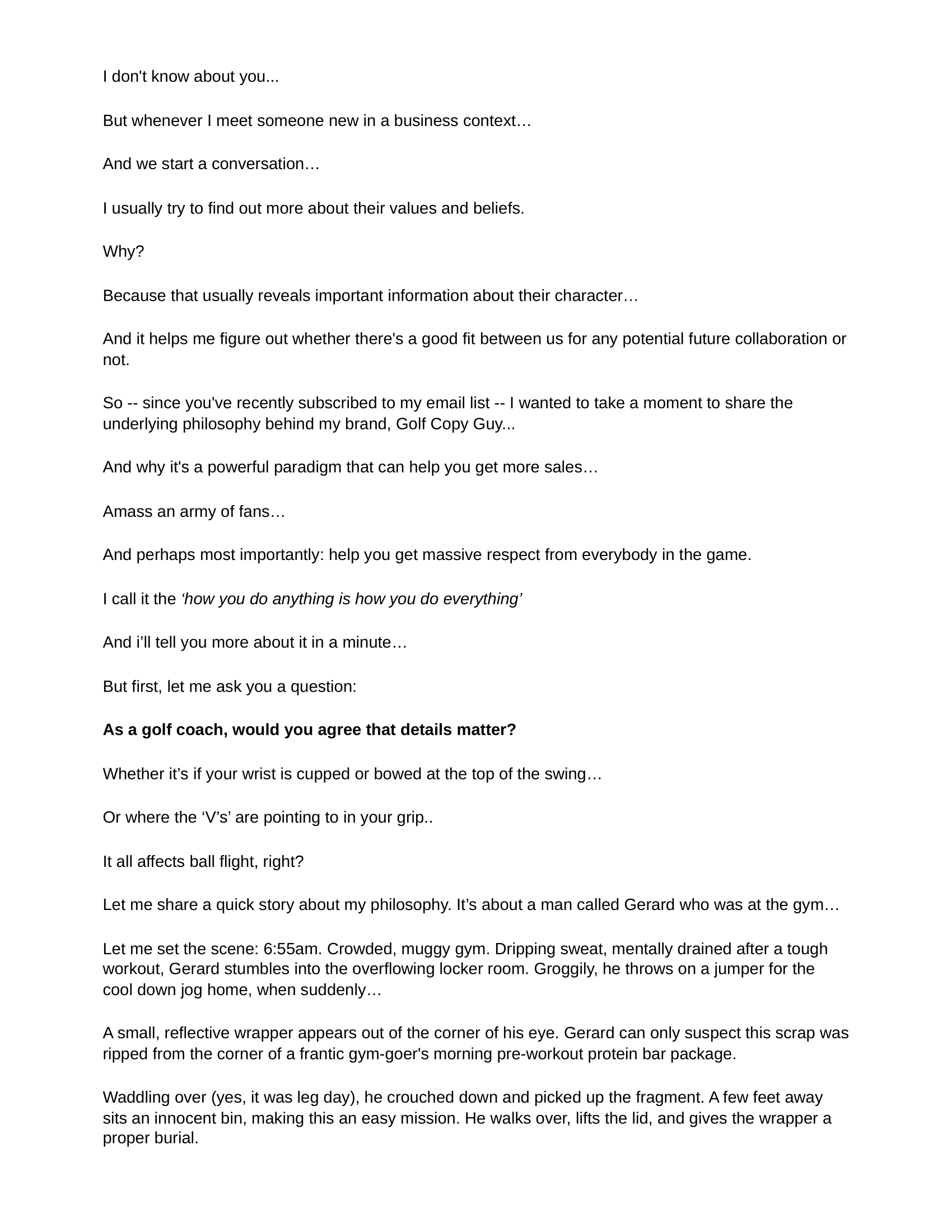
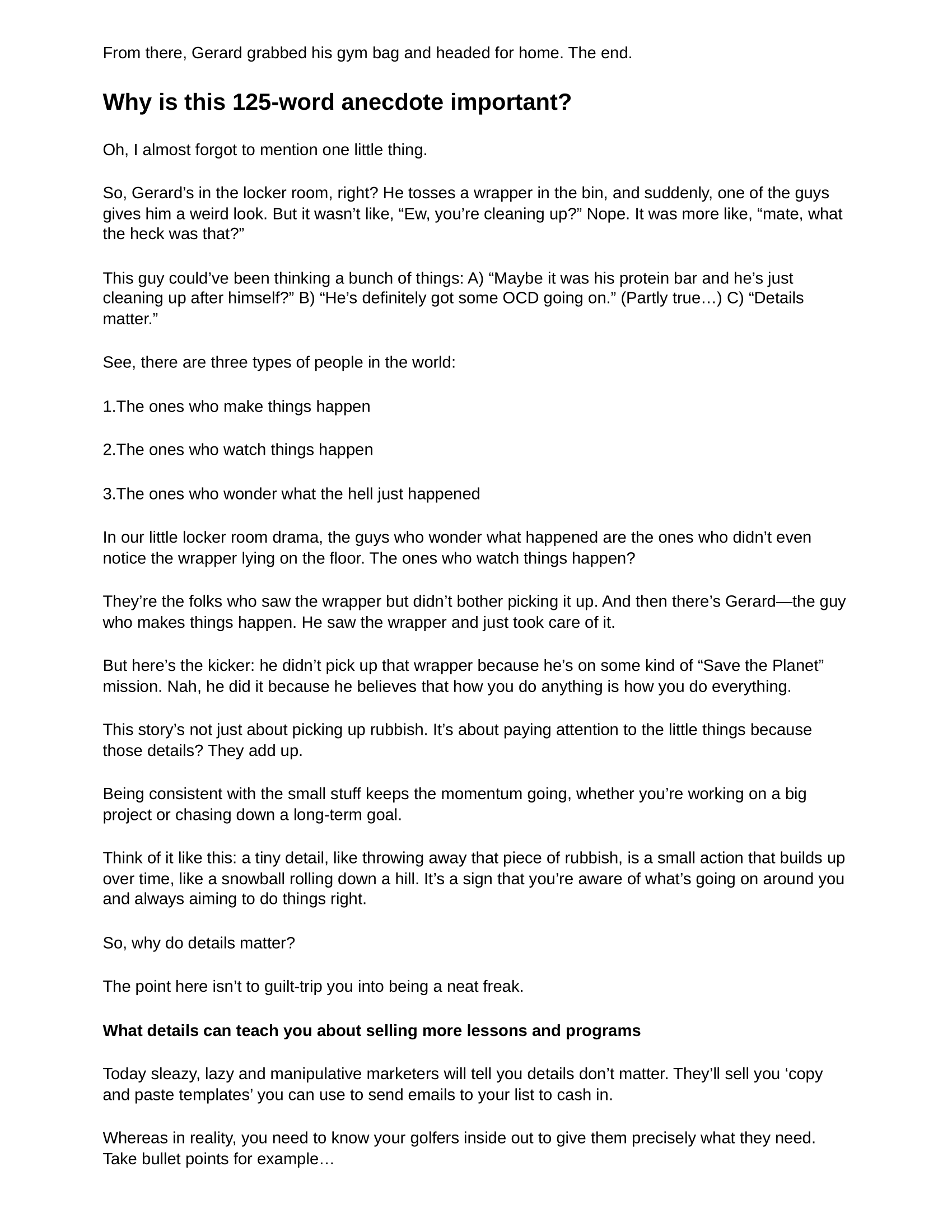
The goal of this email is to state what I stand for (and what I don’t). I believe trying to be everything to everyone sets you up to fail. Instead, be ok with losing prospects, so long as you’re building an army of loyal fans. Therefore I’m looking to:
Share my beliefs which tap into my prospects already existing beliefs.
Keep building more ‘know, like and trust’.
Clearly stand for something so I’ll never be alone.
Other notable points:
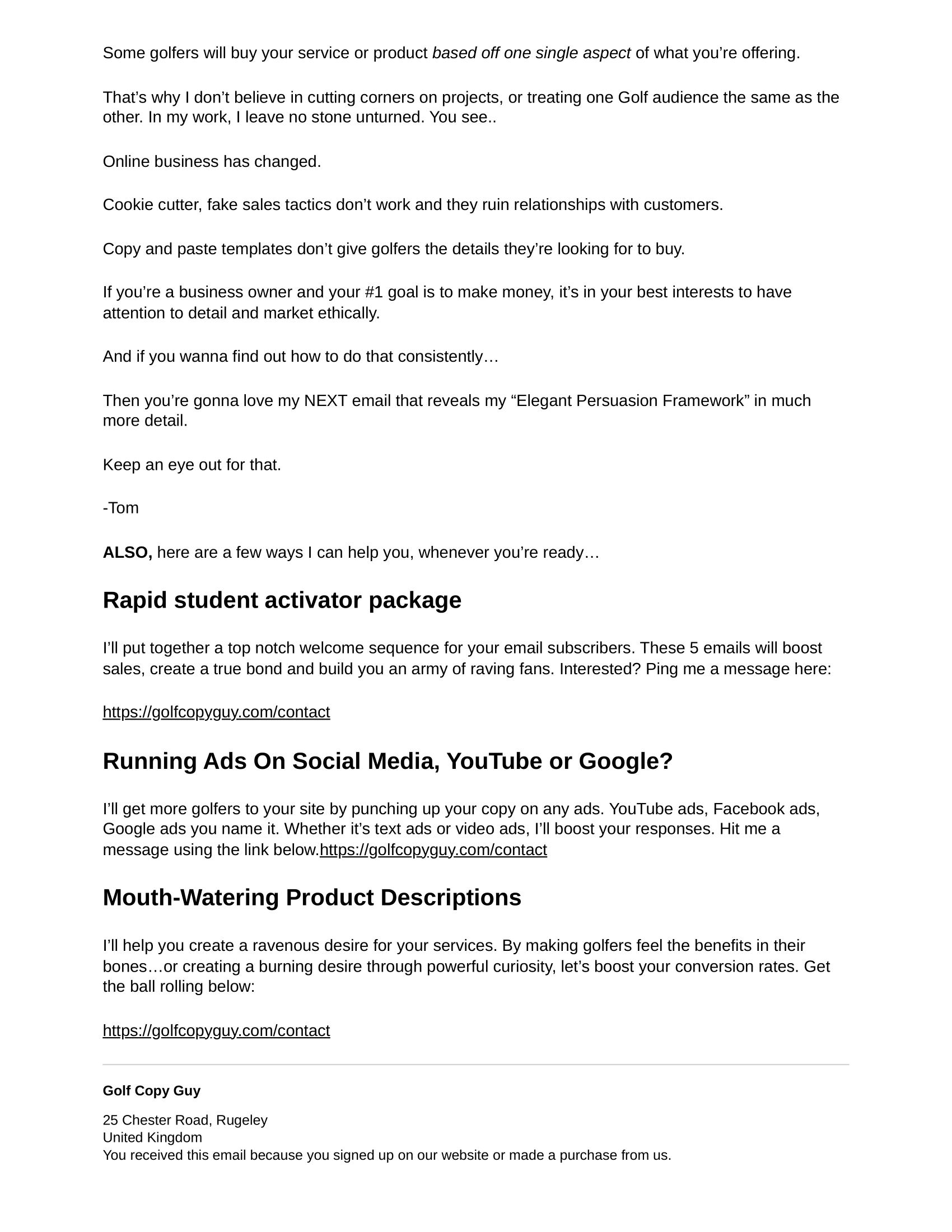
By asking “As a golf coach, would you agree details matter?” is aimed to get a small ‘yes’ in the mind of the prospect. This makes them more receptive and trust details go into my work as a copywriter.
By writing “Whether it’s if your wrist is cupped or bowed at the top of the swing…or where the V’s are pointed to in your grip…it all affects ball flight, right?” I’m demonstrating my knowledge of the golf swing. This is to build trust with golf coaches I’m trying to sell my copy services to. A key objection for golf coaches is hiring copywriters who know little about golf.
Subject Line: Which one of these 3 are you?
Body:
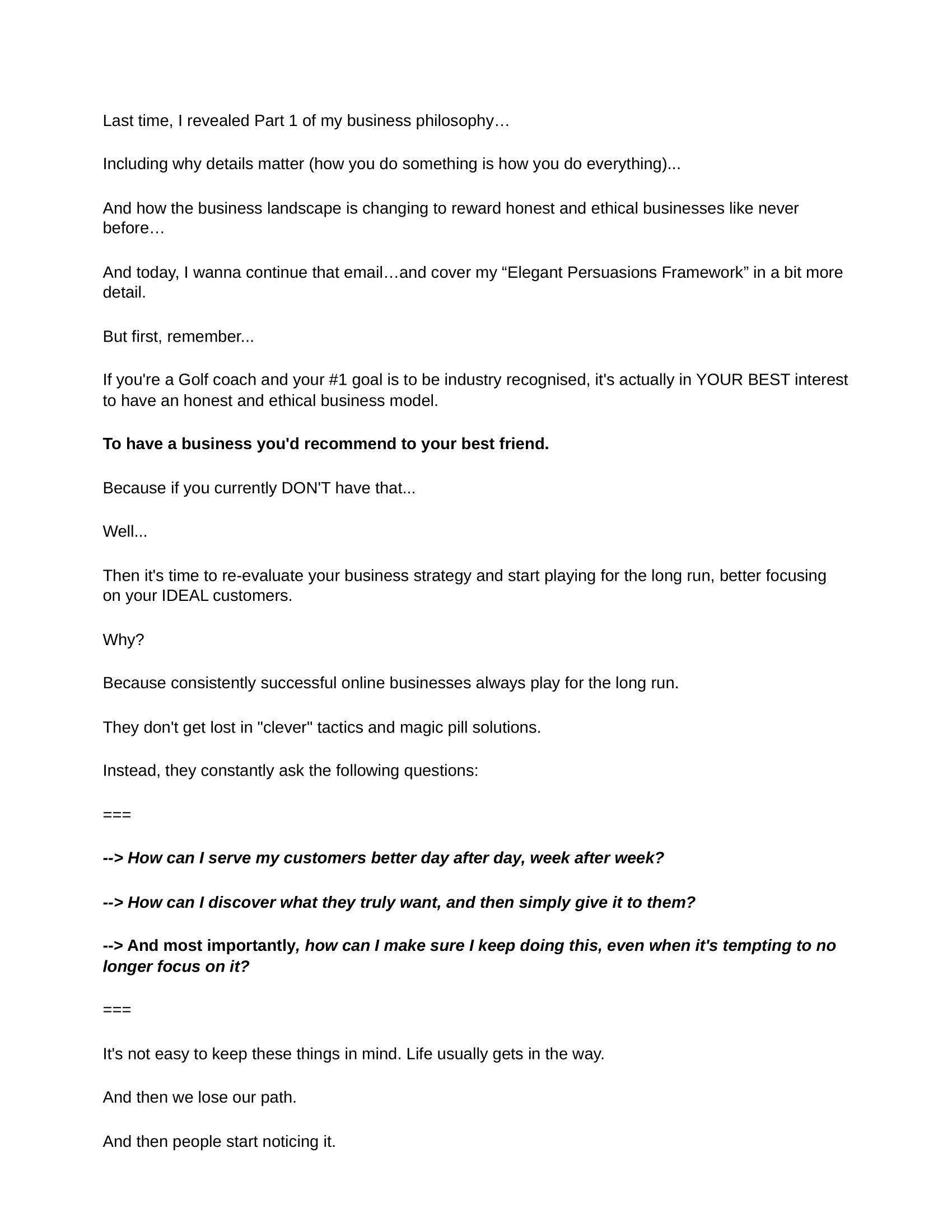
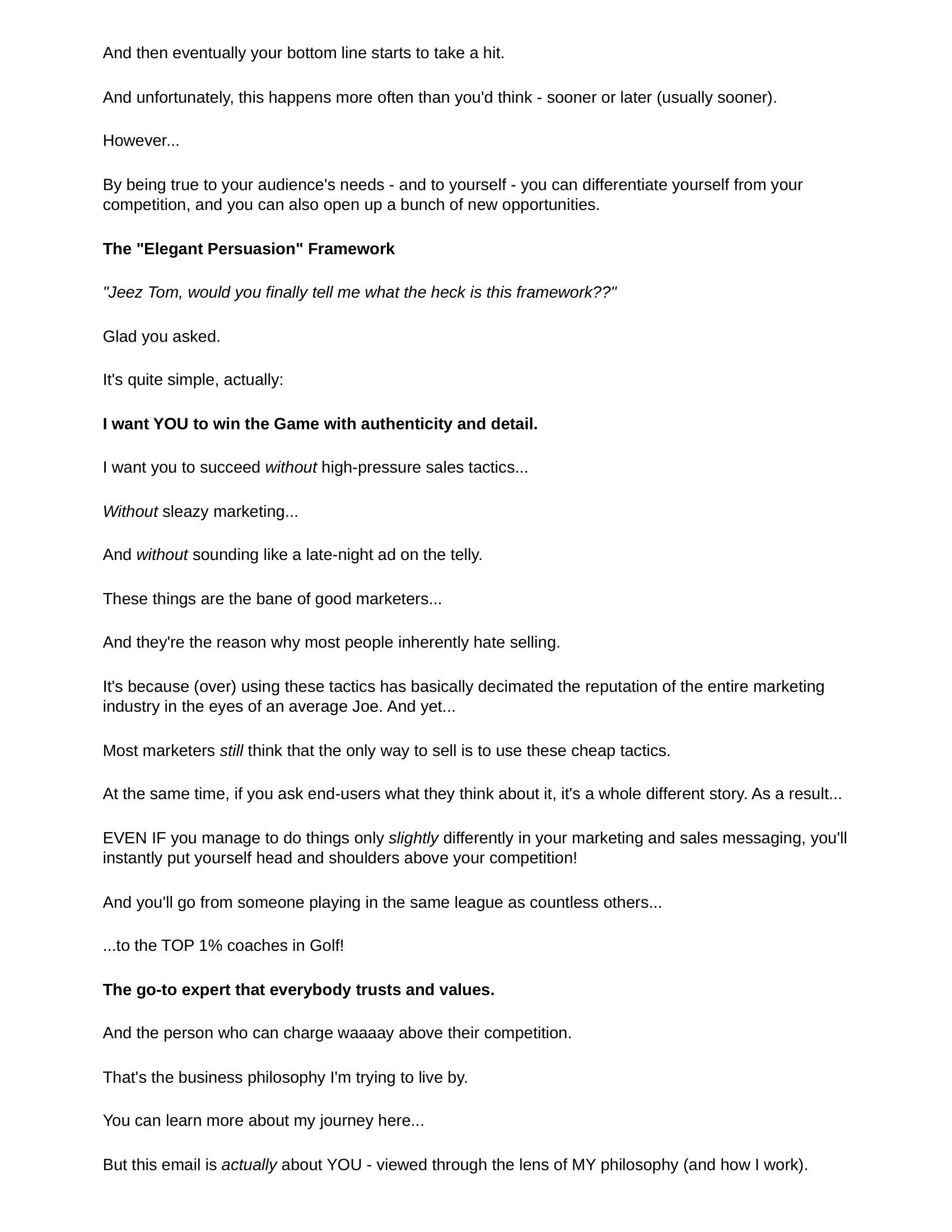
Email #5 - Reason Why I’m Different & Superior
The goal of this email is to separate me from the crowd. Similar to a ‘unique selling proposition’ or ‘unique selling point’. Here’s the structure of the email:
Tap into a problem they’re experiencing as a golf coach.
Highlight how past solutions they’ve tried before haven’t worked.
Explain the real cause of the problem.
Highlight the real solution.
Tie it back to my own service.
Subject Line: 3 questions every top online biz asks
Body:
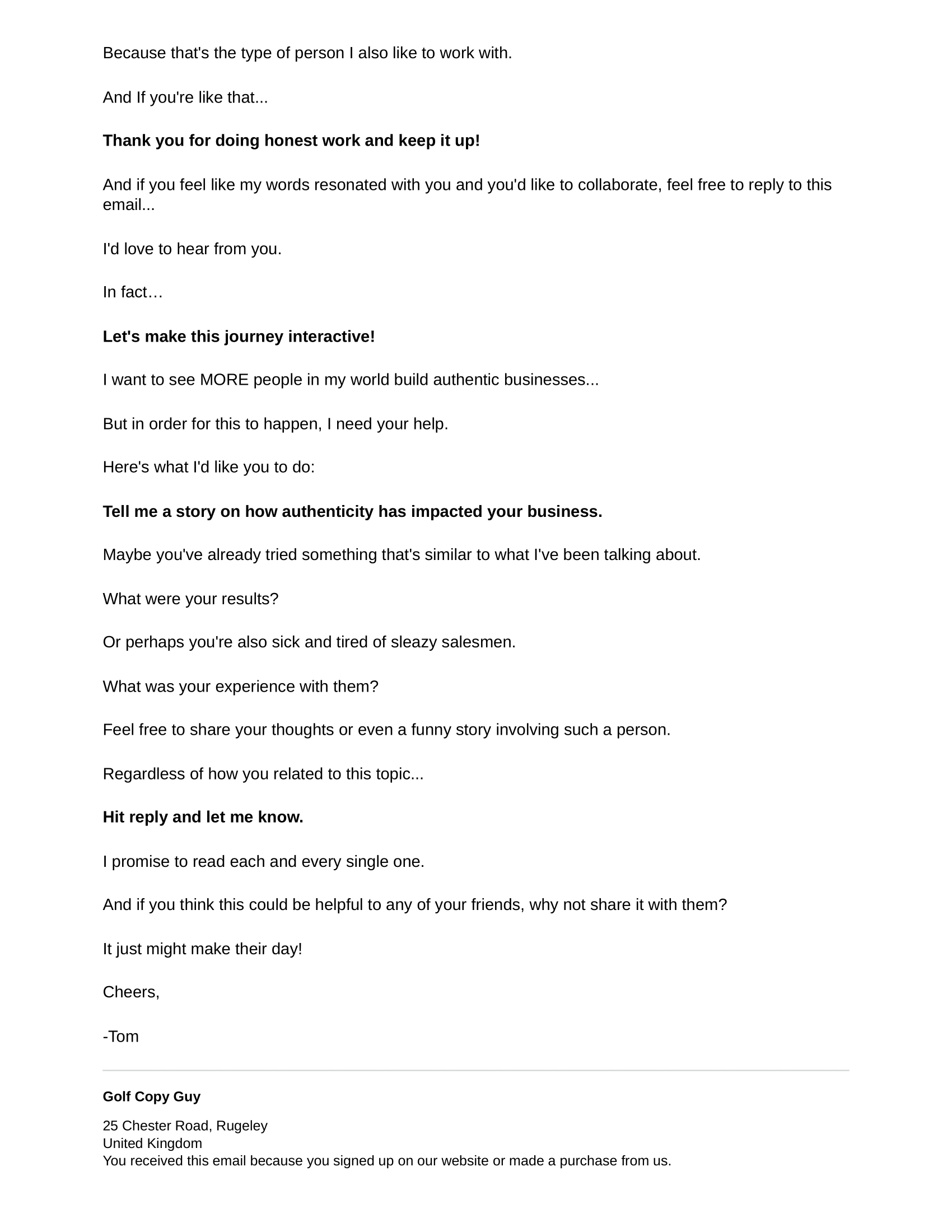
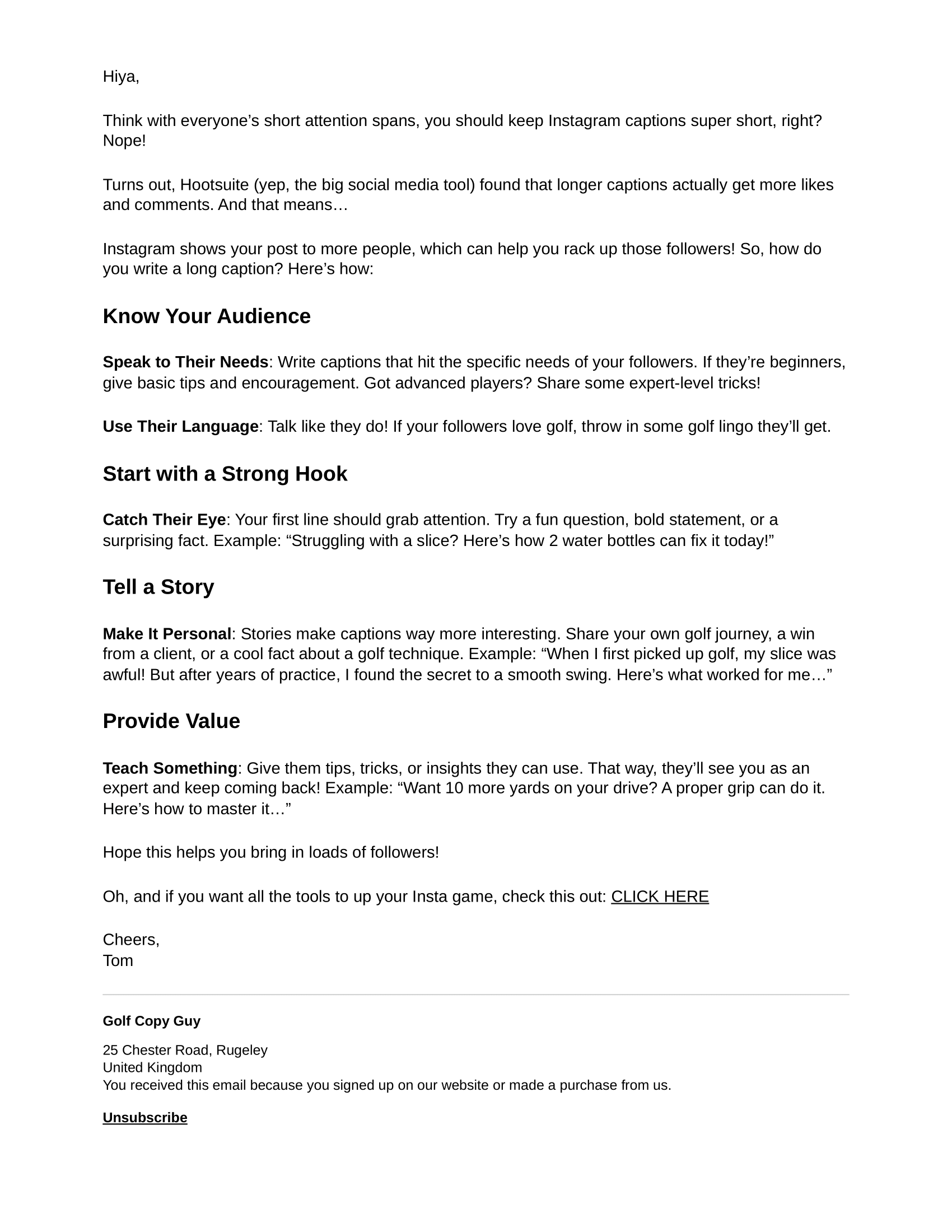
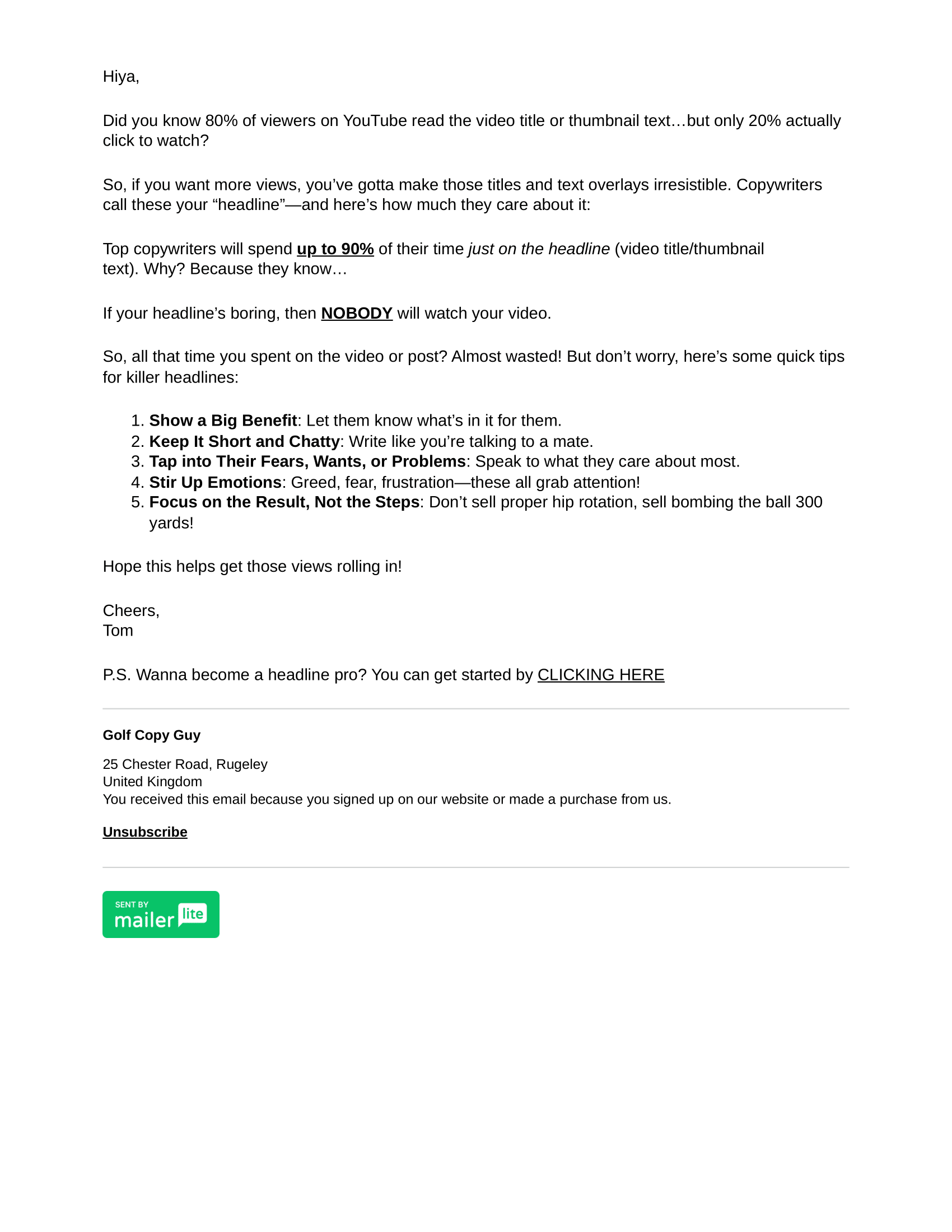
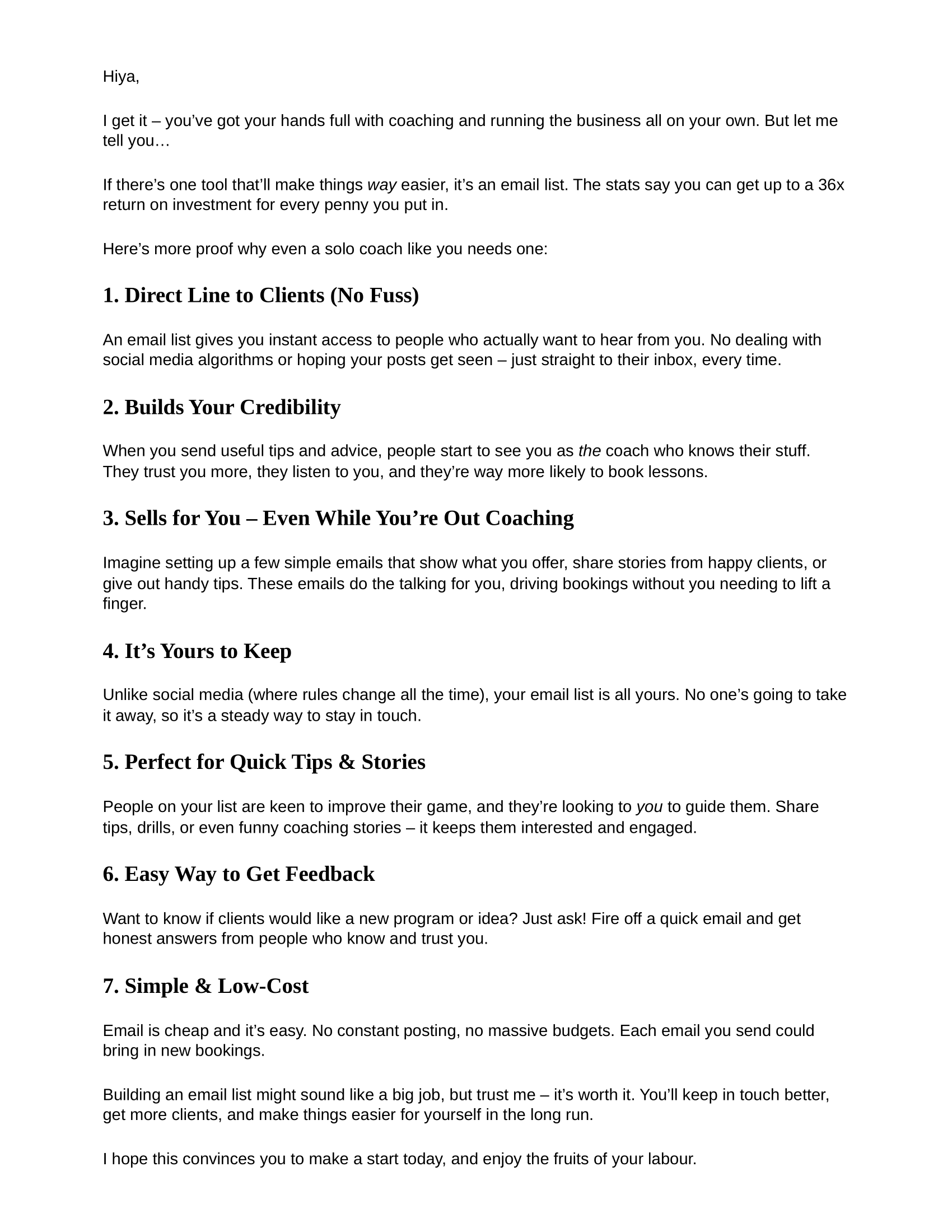
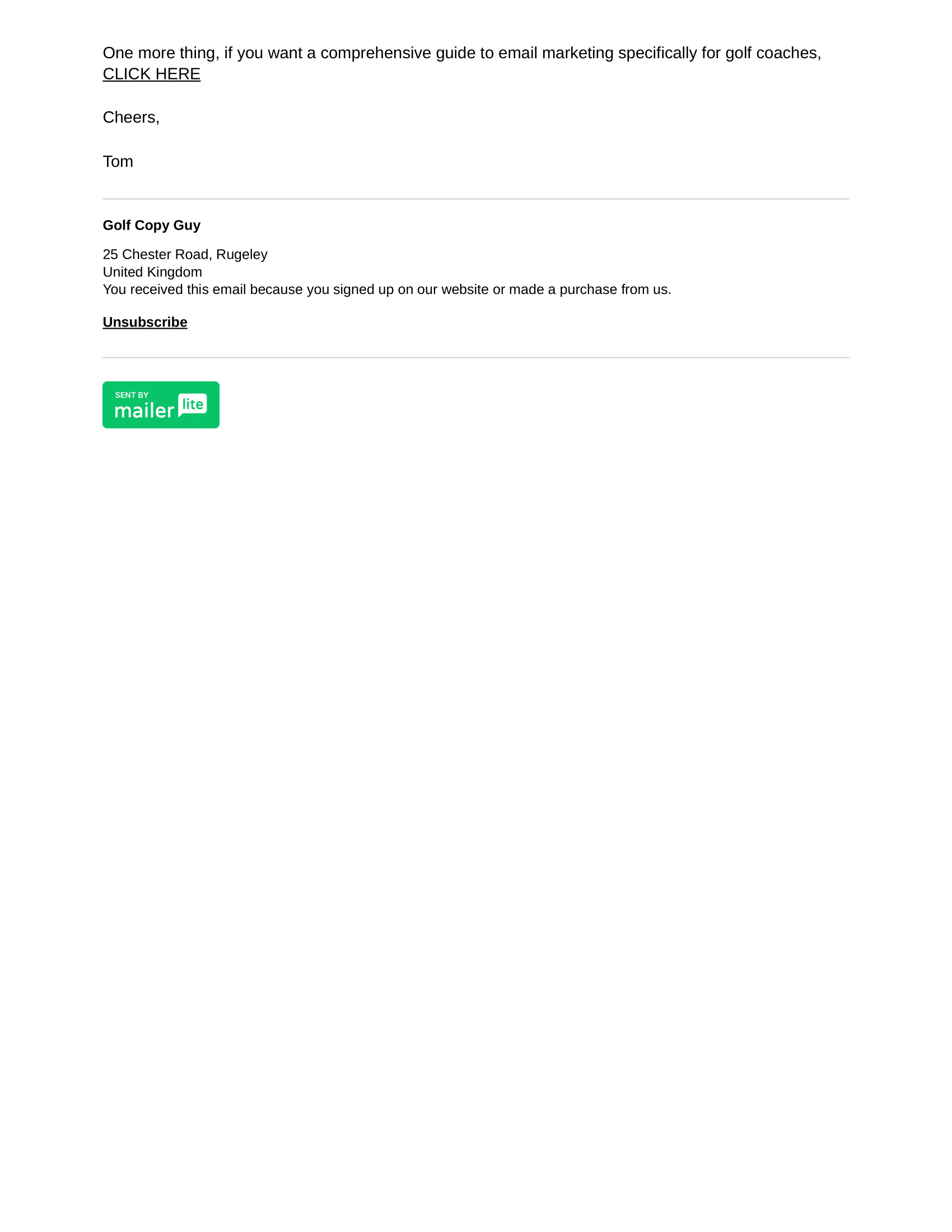
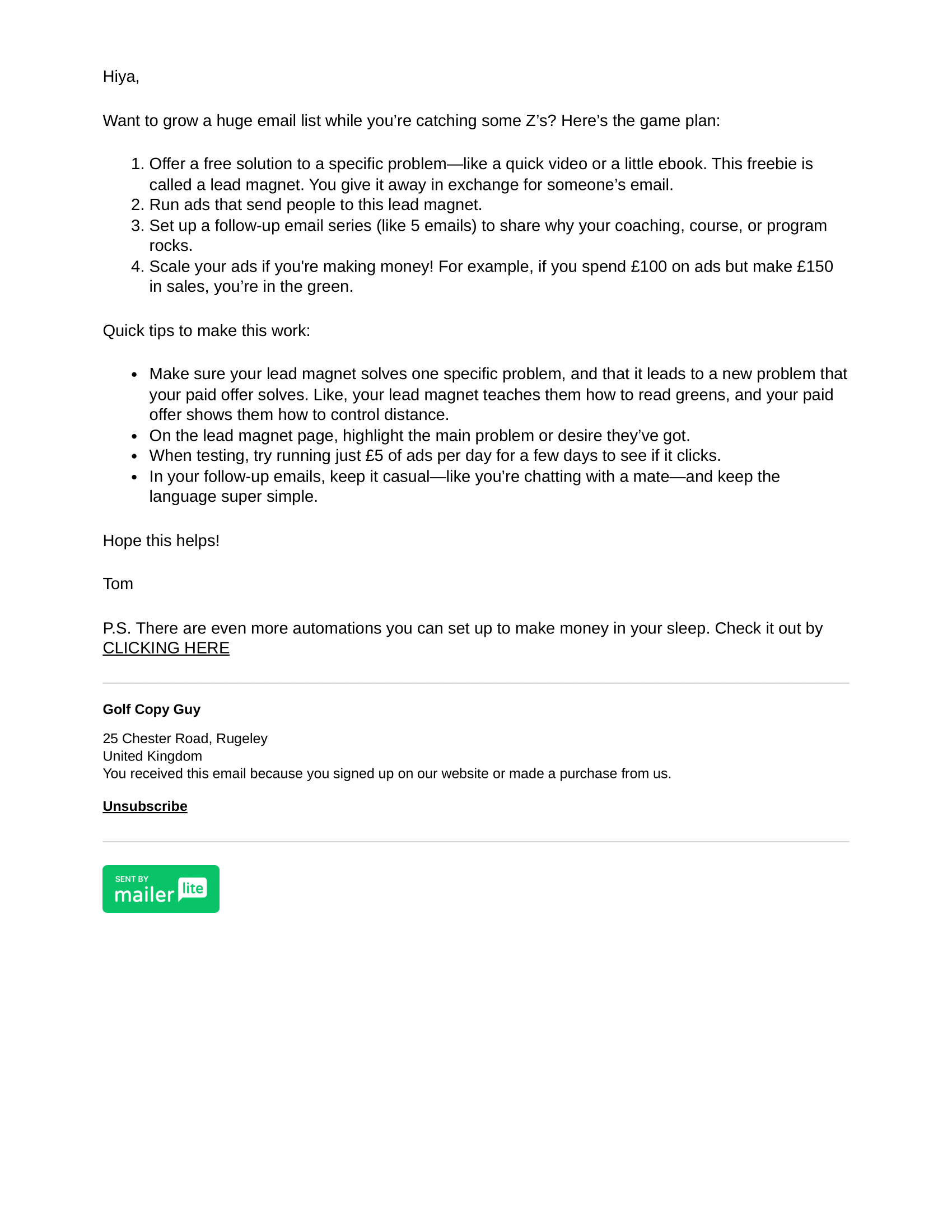
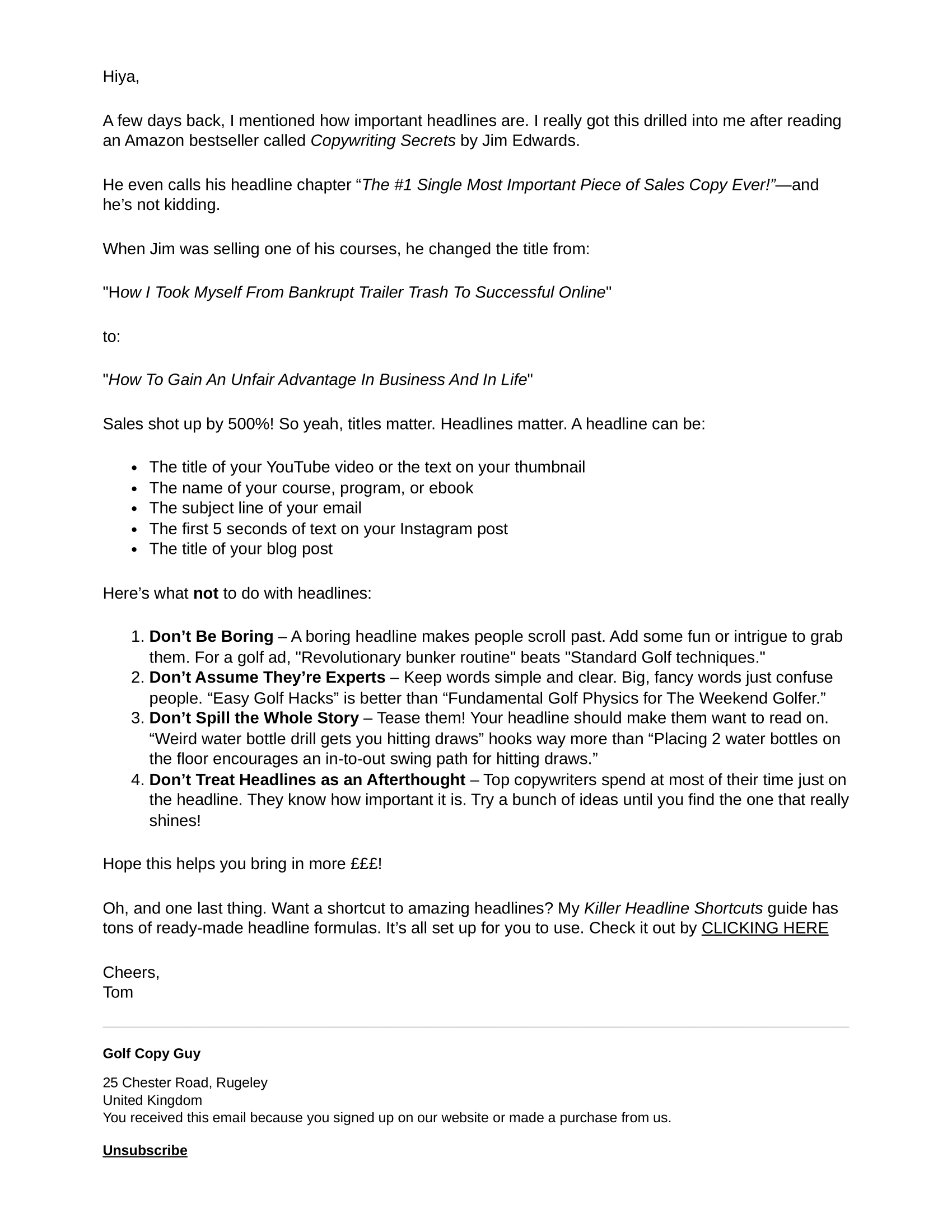
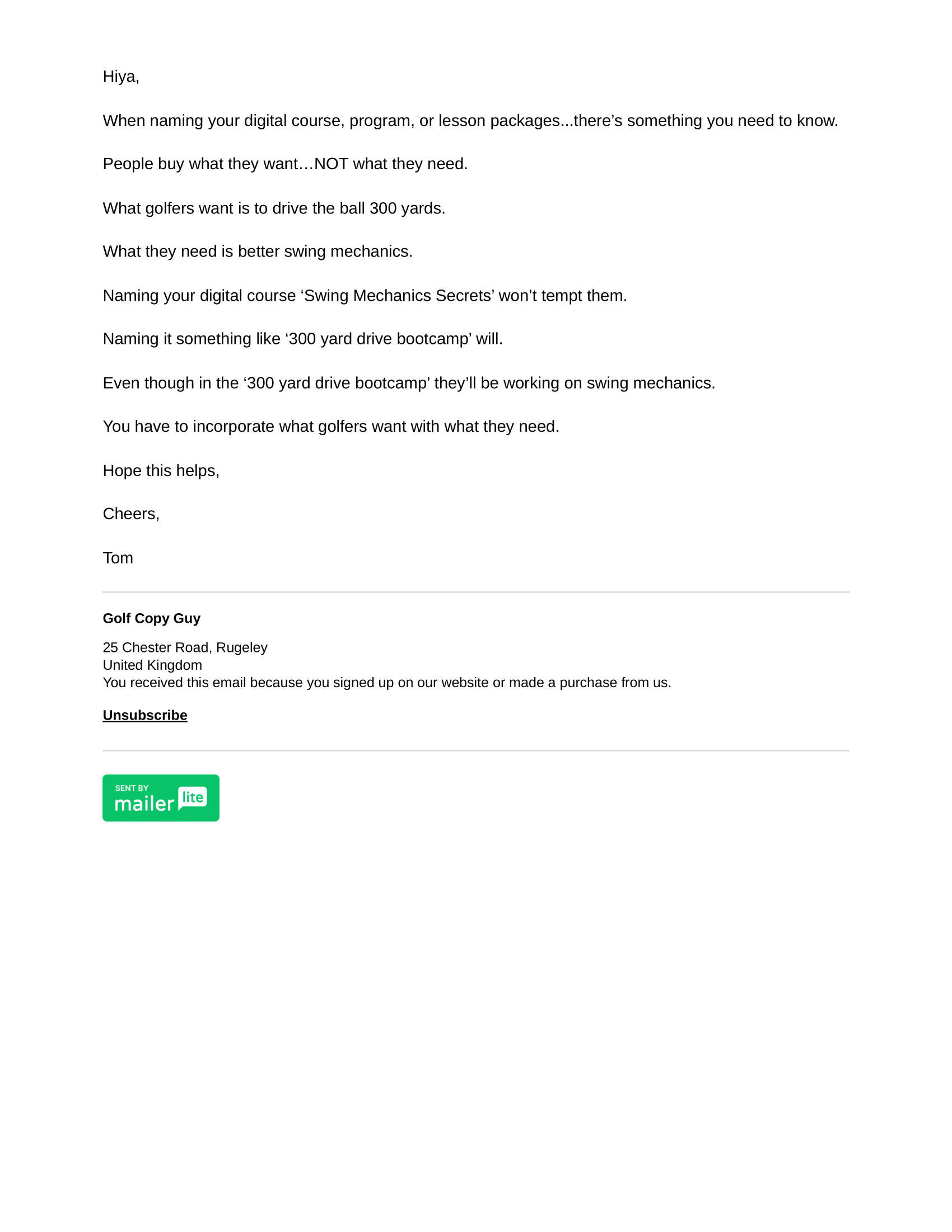
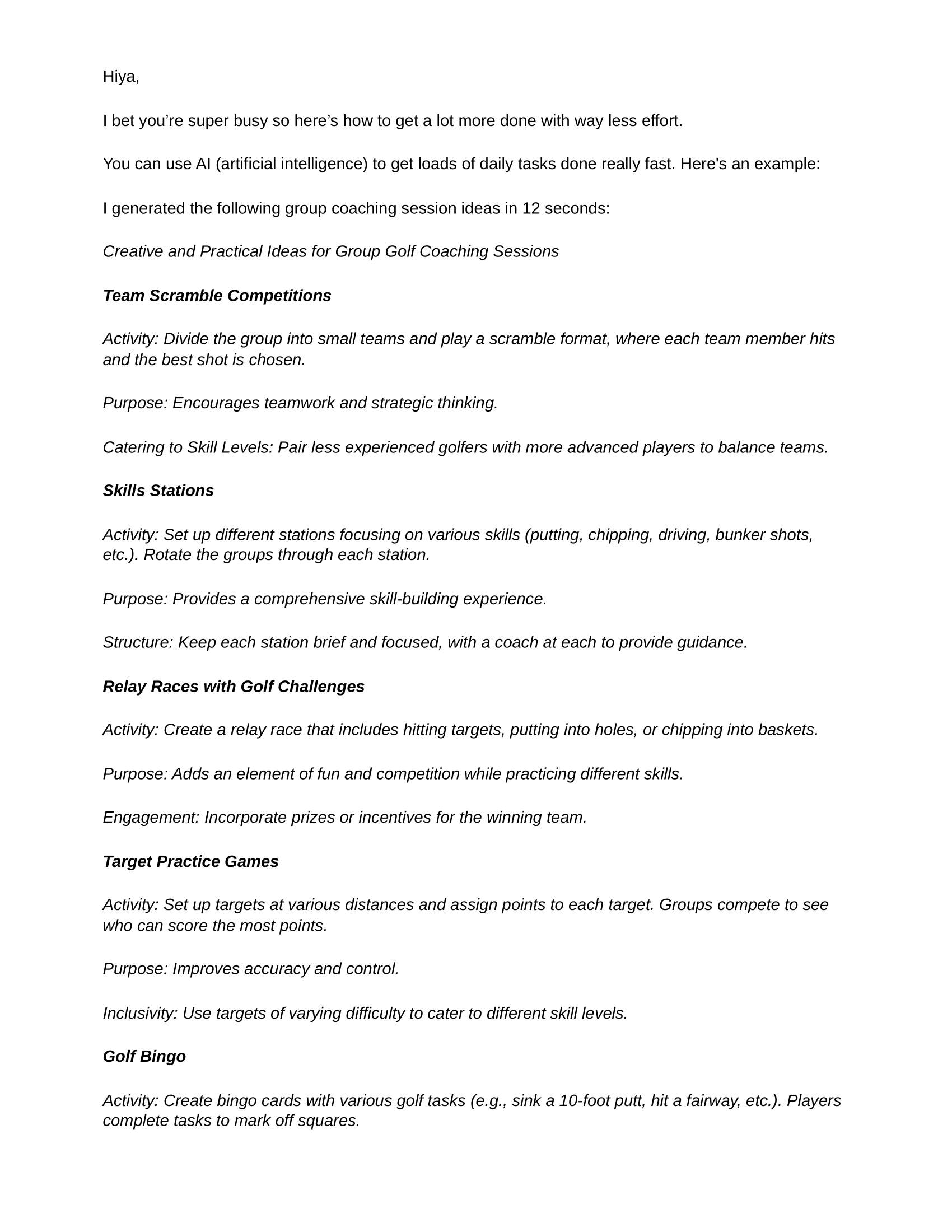
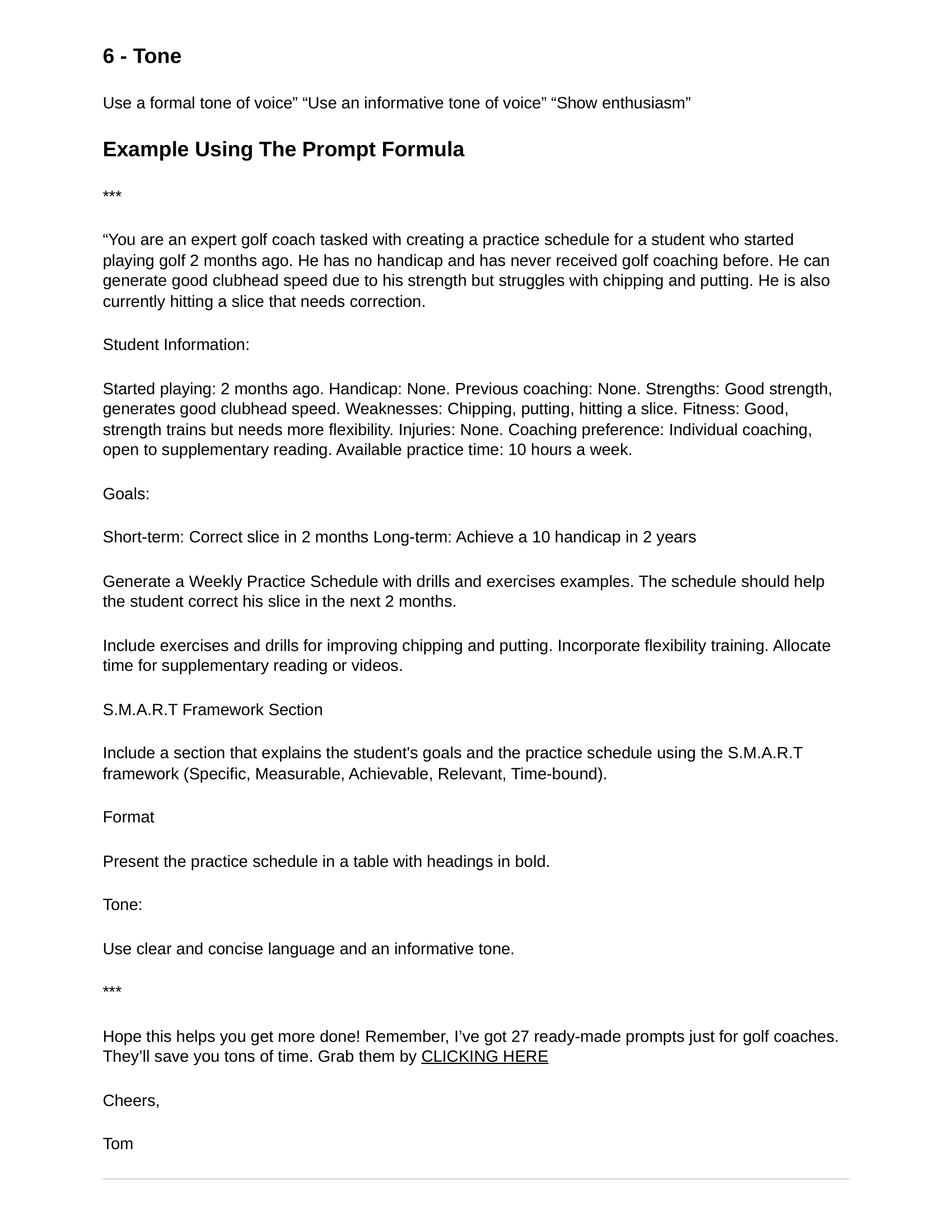
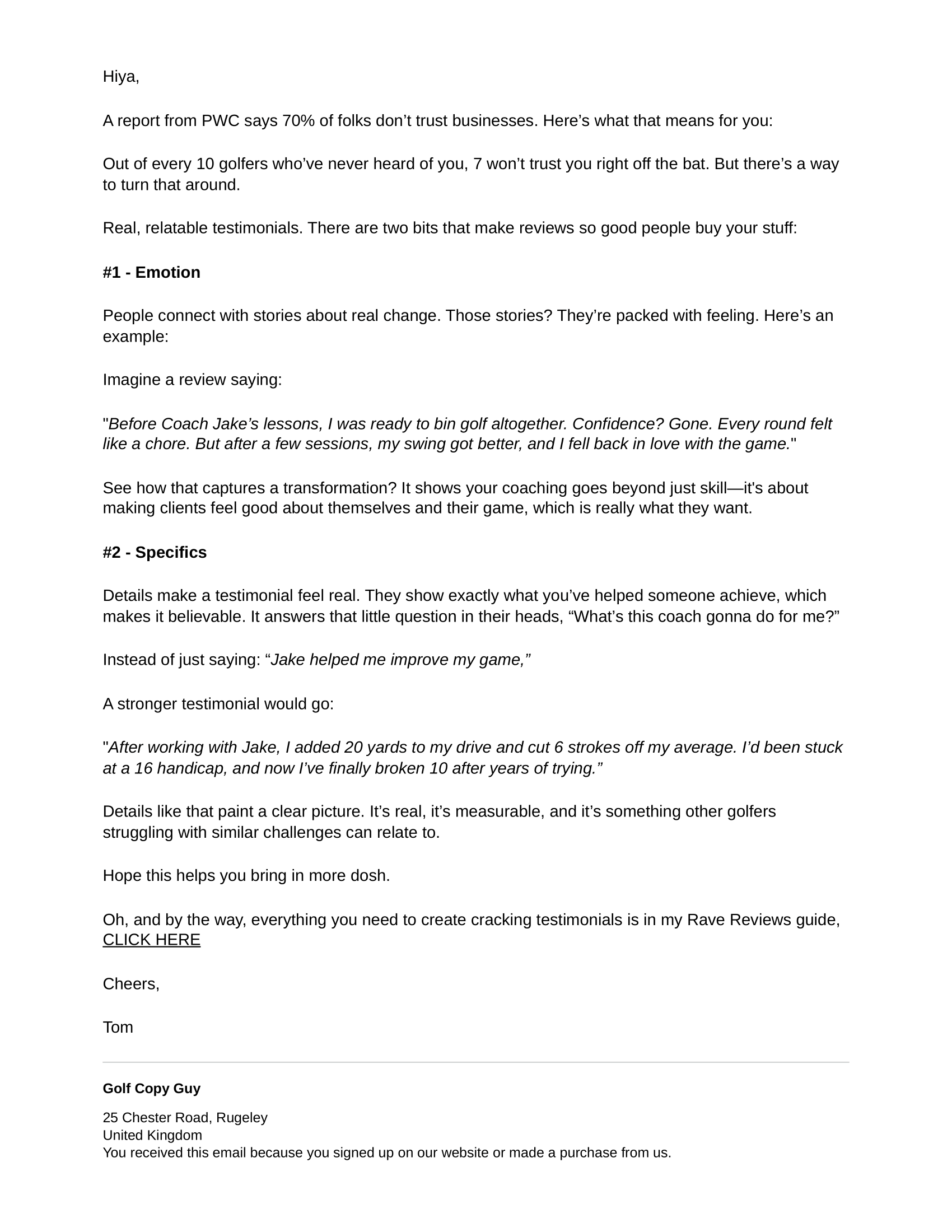
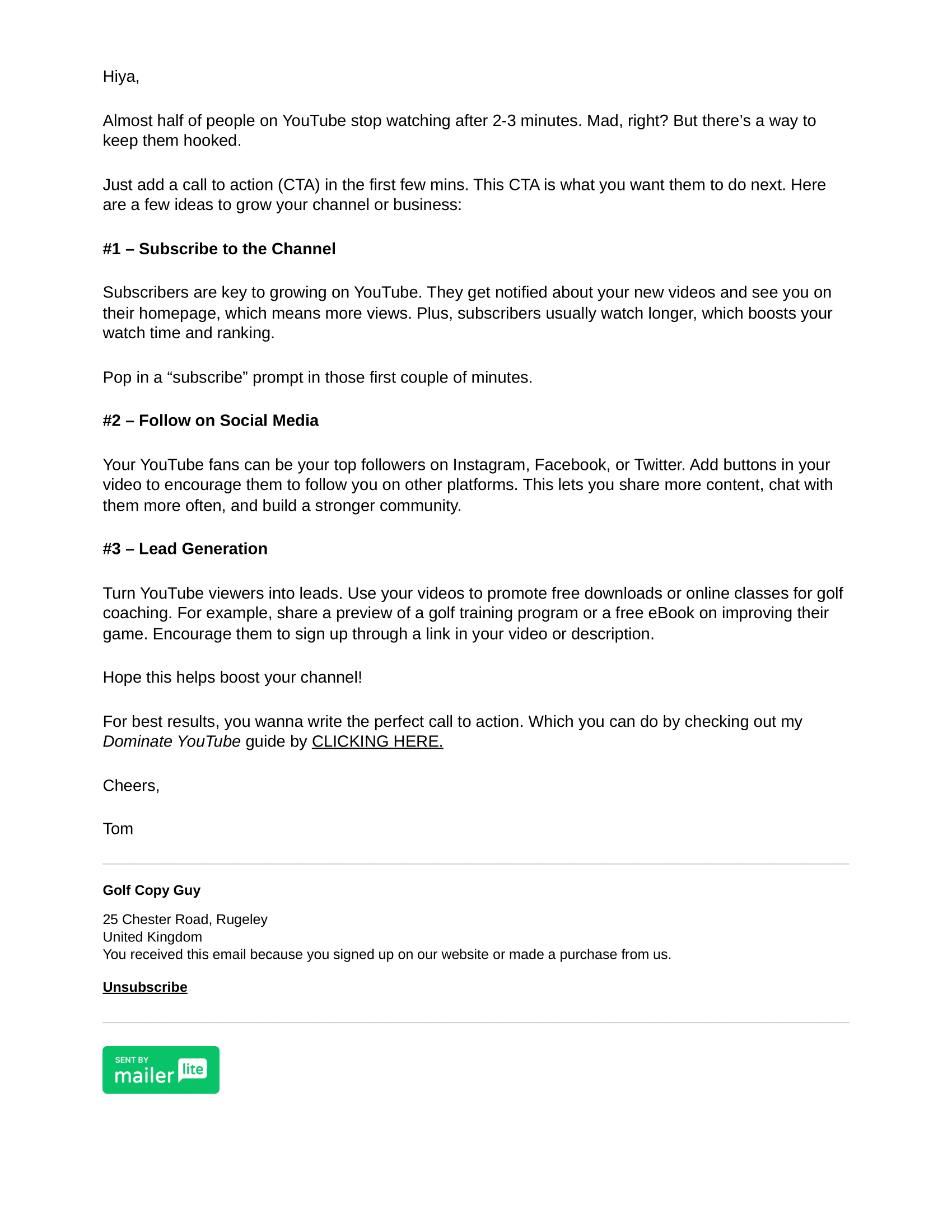
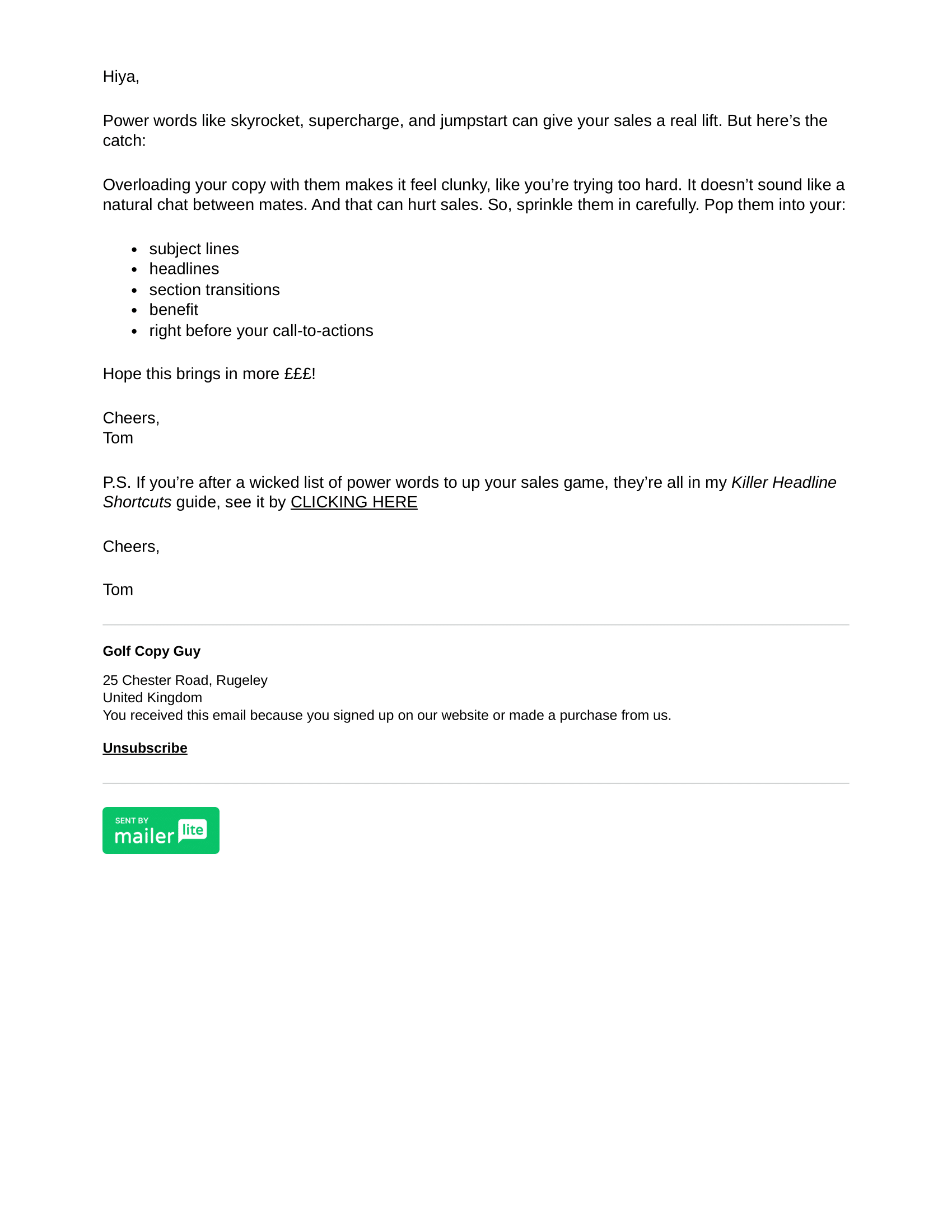
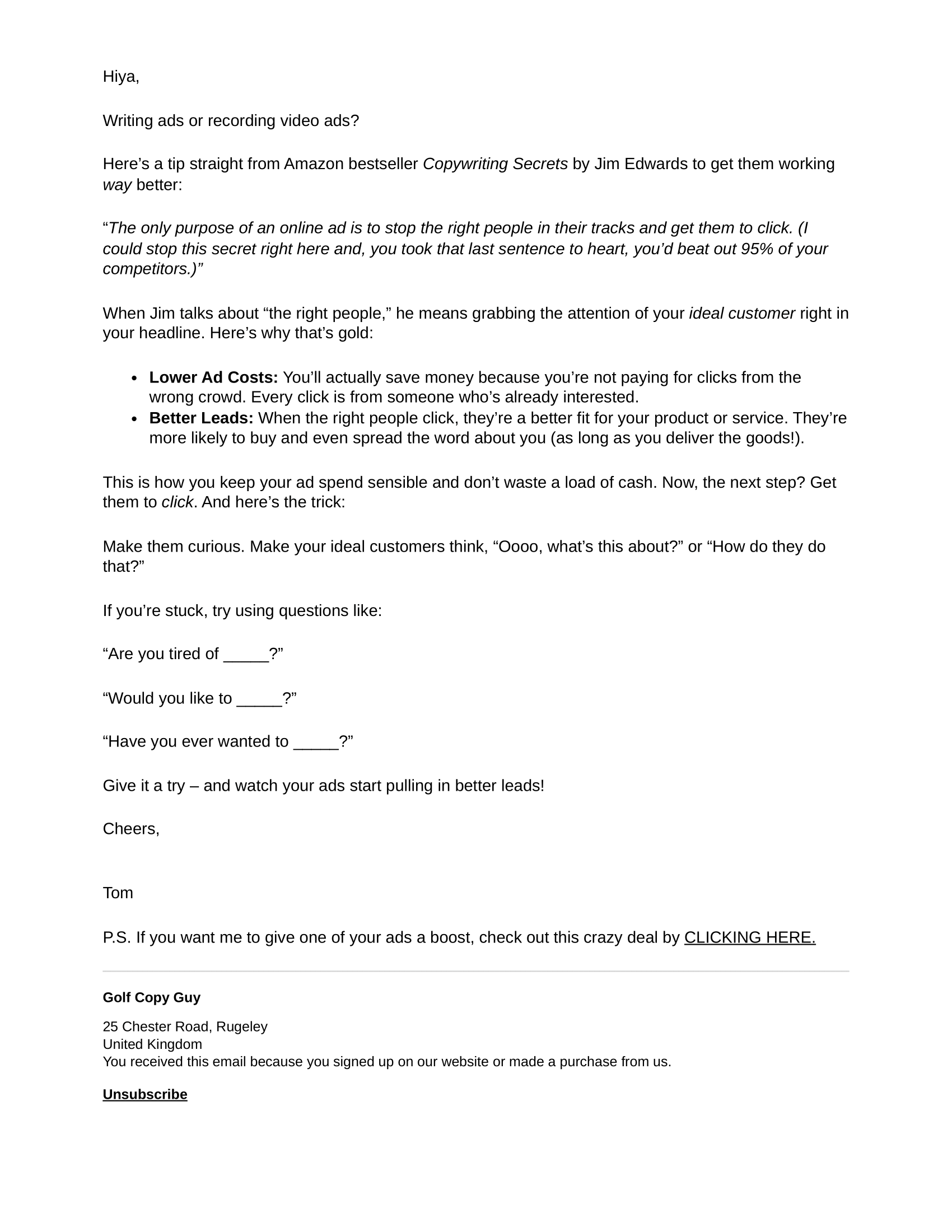
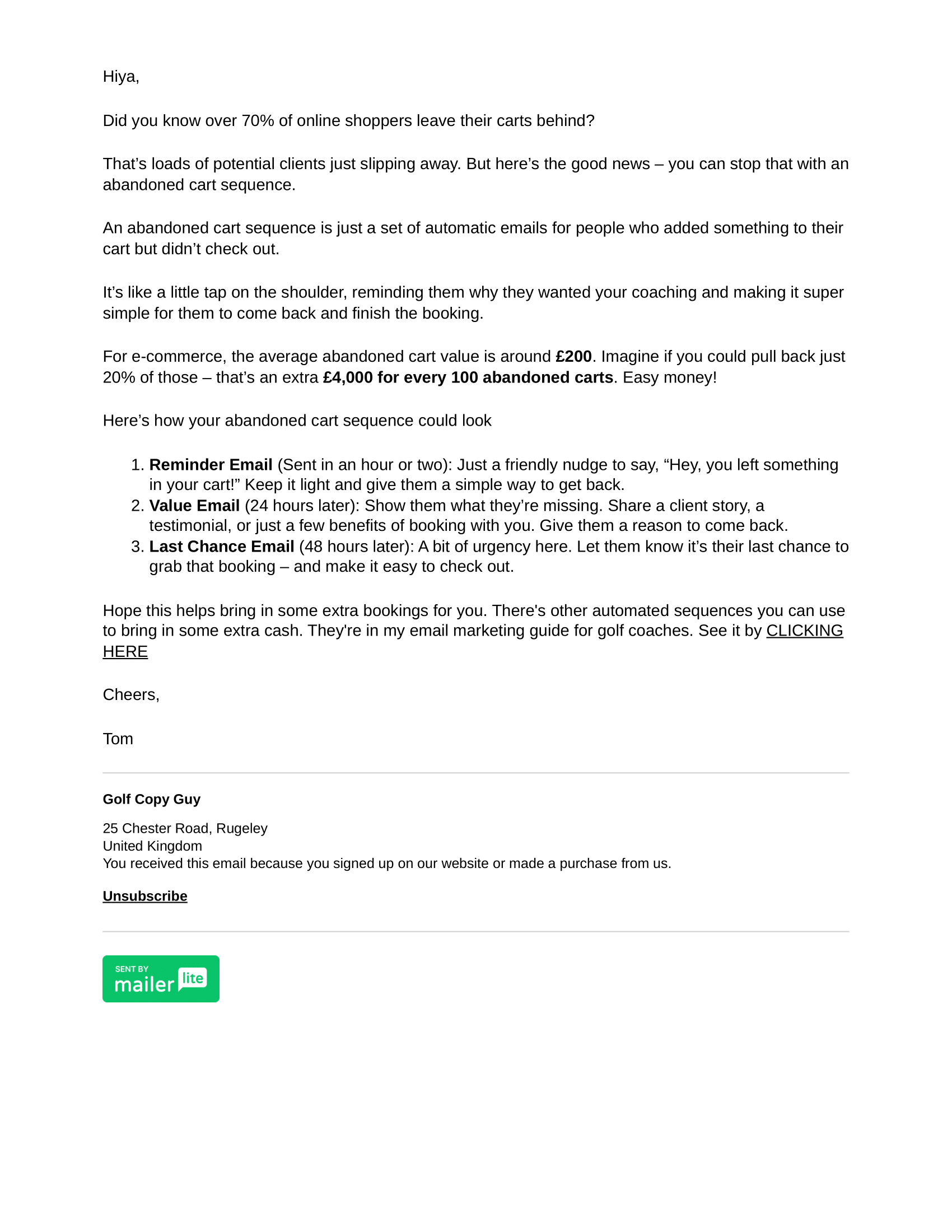
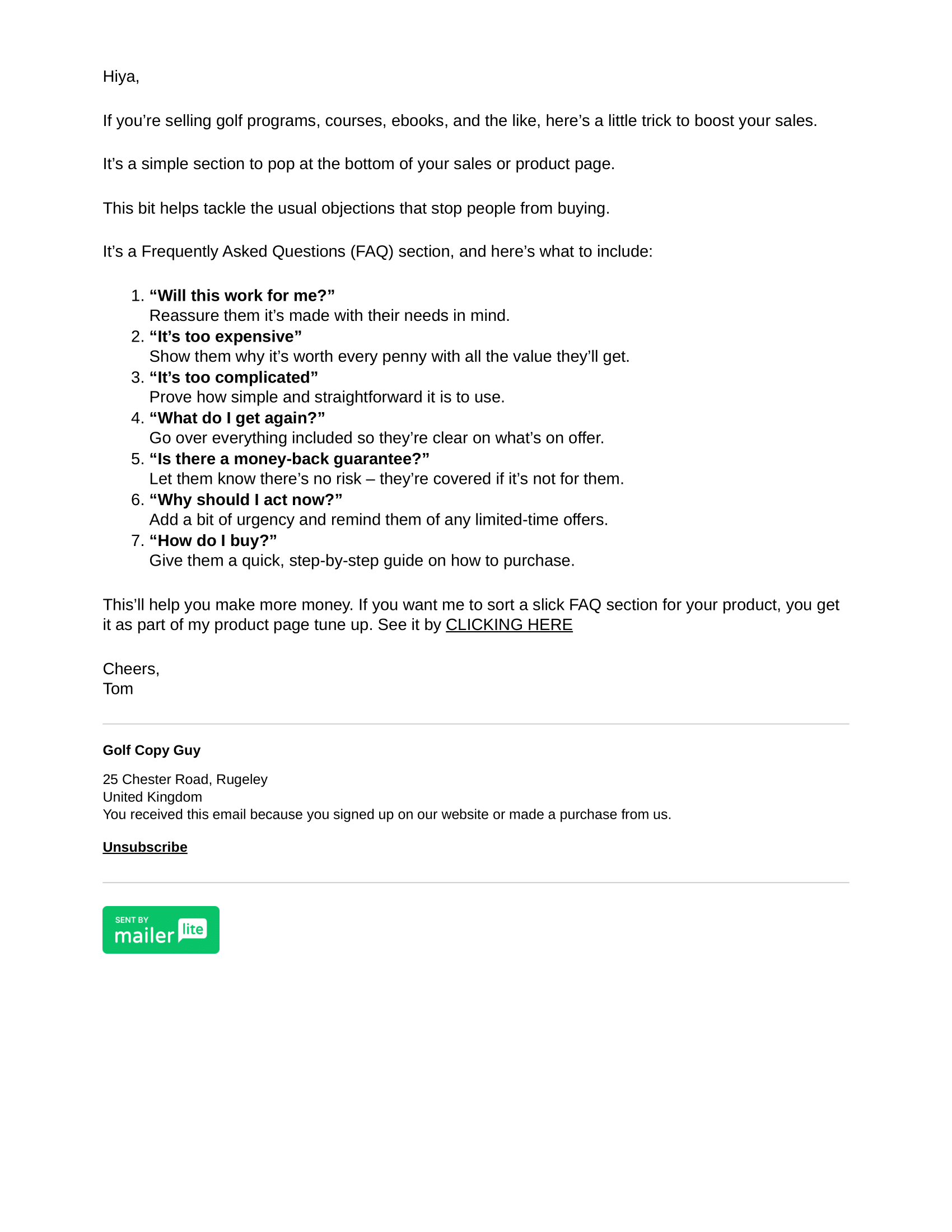
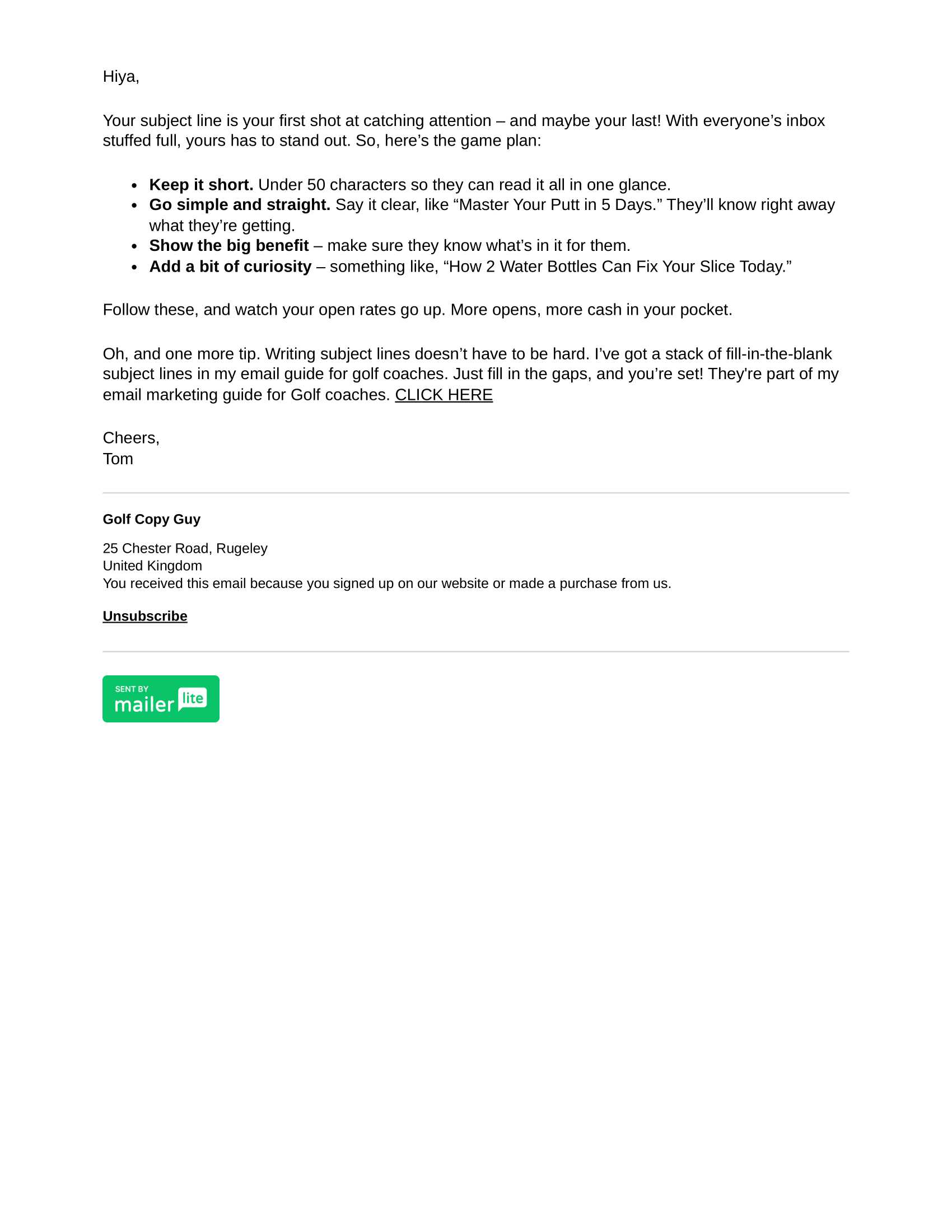
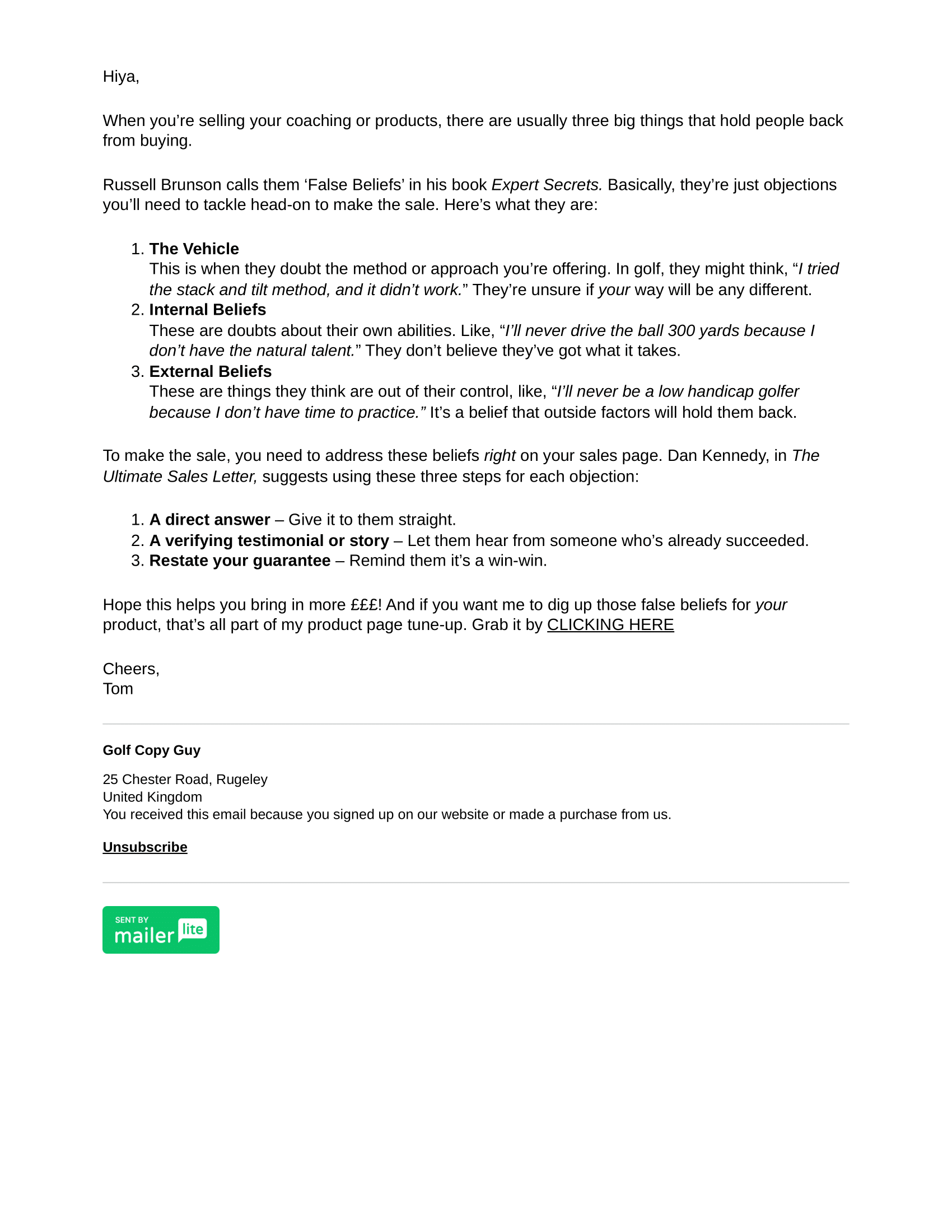
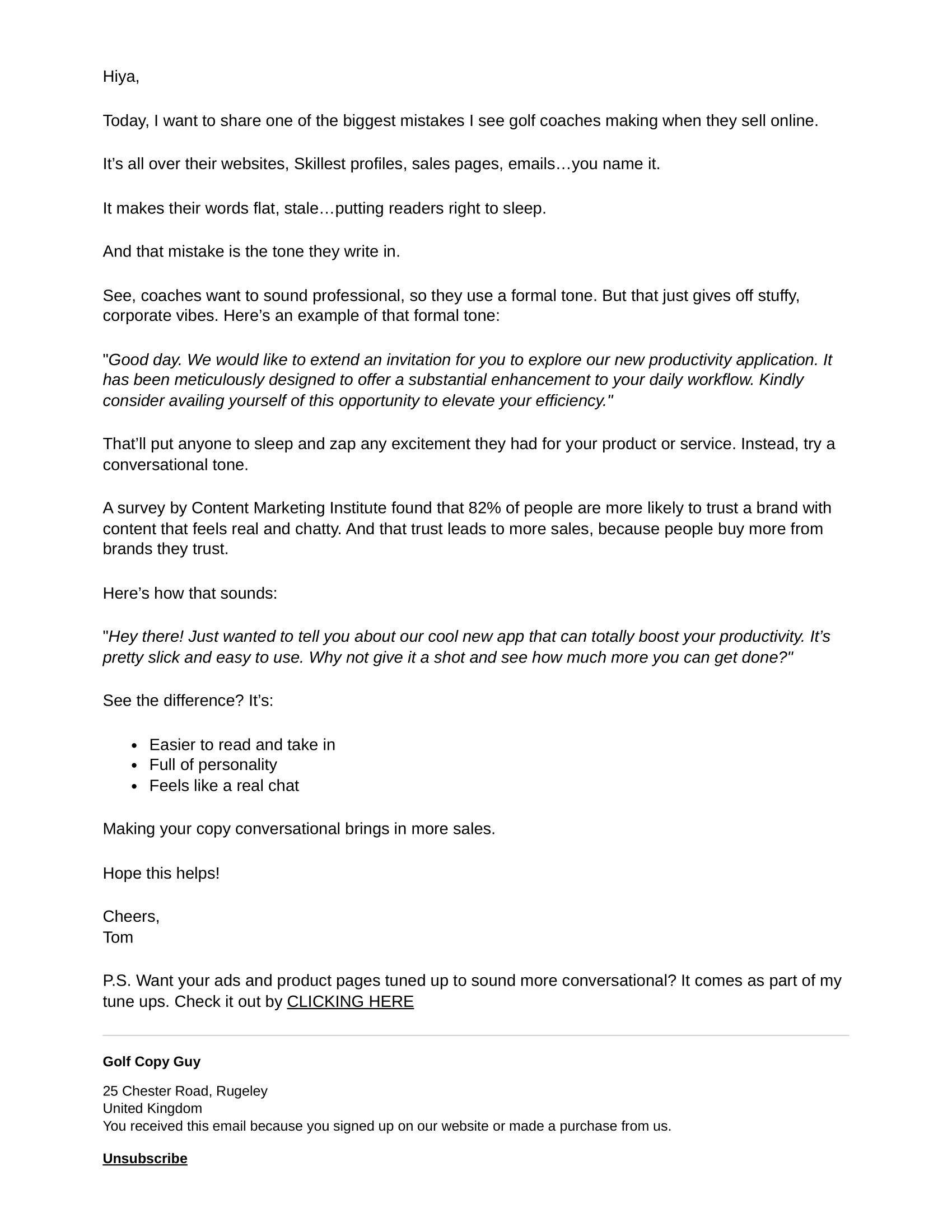
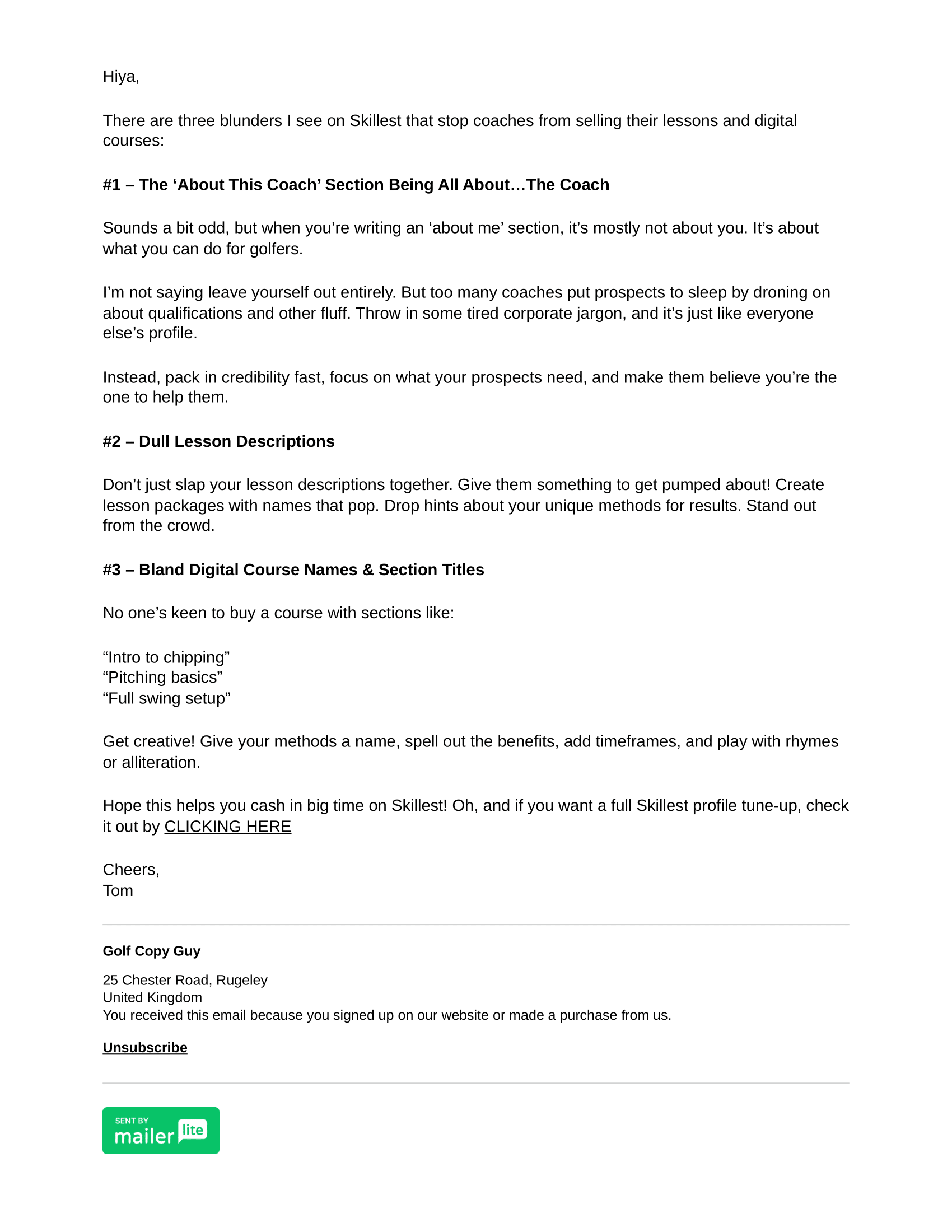
Emails 6-24 - Give Value, Create Curiosity & Sell The Click
Each of these emails follow a similar structure, which is:
Give value upfront to help them solve a problem.
Make them curious to click a link to my sales page.
These emails are mostly short. They're useful and written in a conversational tone to built trust. However, I’m only selling the click, not my offer. It’s my sales page’s job to sell my offer.
Other points to note:
Use of Shocking Statements To Hook Readers - In some emails you’ll see the first line of the email gives a shocking statistic aimed at the reader. I do this to get the prospect to think “Wow I need to read this”. Once they’re emotionally invested, they’ll keep reading.
Provide Genuine Value But Always Sell - Each email contains useful information for the prospect. I never want to get the prospect to ignore my emails as they think it’s all sell, sell, sell. However, as you see, I always find a way to link in the product I was selling, even if it’s just in the P.S.
Use Super Easy To Read Formatting - People are busy and have no patience and small attention spans. My emails have one, two or maximum 3 line paragraphs and are shortish mainly. This doesn’t overwhelm the reader when they open the email, making them more inclined to read.
Client Project - Golf Coach Video Subscription Sales Page Rewrite
Overview
In this project I rewrote a client's golf coaching sales page. He has a subscription based website in which buyers get access to a library of golf instructional videos, to help them play better Golf.
My Approach
The first step as in any project was to do avatar research. A detailed breakdown of golfers' fears, desires, results, challenges, objections, questions and beliefs.
The next step was to watch all of the coaching videos inside the subscription. This allowed me to build a huge list of benefits to create maximum value for a prospect. Additionally, I looked for details which would be contrary to the prospects beliefs, to surprise them. These would be used as curiosity bullet points on the sales page, and potentially for headlines as they’d grab attention.
Copy Highlights
Build Curiosity With Counterintuitive Bullet Points
Once I understood how the prospect thinks, I knew what content in the subscription would peak their curiosity. By creating an ‘open loop’ in their mind, the only way to close it would be to buy. Many golfers assume swinging faster will hit the ball further. Which is why I’ve written the bullet “”Why slowing down your swing actually makes you hit it further”.
Crush Objections In Bullet Points
During my prospect research I found objections which I crushed whilst combining them with benefits. For example, a common objection was golfers not having time to hit thousands of balls in practice. Which is why I wrote “How to fix your swing without hitting a single ball”.
Use Golf Legends To Build Authority
My client has got some of the golf drills in his content from some of the best golfers to play the game. Which made it possible for me to use it to build authority. If a golfer thinks 7 time major champion Nick Faldo does this drill, it must be a good drill right?
Find My Clients USP
There are thousands of golf coaches out there. So I needed to find what is unique about my client otherwise he’ll get lost in a sea of competitors. During the client call, I found out he was only 1 of 9 Malaska Certified Golf coaches. This is an accreditation from Mike Malaska, one of the highest rated coaches on the planet. This stands him out from thousands of other golf coaches.
Build My Clients Credibility To Boost Conversions
Similar to the previous point, my client is only one of nine coaches who are certified to teach Mike Malaska’s ‘M System’. With Mike being a Golf Digest Legend of Instruction, and handpicking my client to teach his system, makes you think my client must be a good golf coach to achieve this. This gives the prospect confidence he’ll solve your golfing issues.
I'm waiting for the client to upload the copy to his website, so I can get a screenshot. Here's the copy:
Swing Simplicity
Get in on ‘The M System’ to kill confusion, stubborn bad habits, and start smashing it miles
[BUTTON - START YOUR FREE TRIAL]
Here’s EVERYTHING you get…
Putting It All Together: Building An Athletic Golf Swing Video Series (£47 Value)
If your swing feels out of whack, this video series will get you back on track. You get the secret to a smooth, repeatable swing. It all comes down to nailing three key things: rhythm, tempo, and timing. Inside this video series, you’ll also find out:
Why slowing down your swing actually makes you hit it further. Sounds backwards, right? But smooth and steady beats fast and frantic every time—just ask Ernie Els.
The easy way to add 20 yards without swinging harder. More distance without extra effort? Yep. One simple rhythm tweak gets you hitting it flush—and using shorter irons into the green.
Why bad posture wrecks your swing (and your back). Too much knee bend? Stiff spine? That’s a one-way ticket to weak shots and a sore back. Here’s how to fix it so you hit it longer and feel better doing it.
Why your feet matter more than your hands in your swing. Your hands don’t run the show—your feet do. Shift your weight the right way, and you’ll pure it every time. (Bonus: You’ll be launching those low, piercing bullets that cut through wind like a knife.)
How to fix your swing without hitting a single ball. This “All Together” drill (straight from a Ryder Cup legend) gets your whole body working in sync. No range time needed.
The perfect takeaway (and how to nail it every time). A bad takeaway is a slice waiting to happen. The “Front Loader” drill keeps your club on plane and your shots on target.
Your tempo controls everything—power, timing, and confidence. Nail your rhythm with this easy 4-count trick, so even when your nerves are off the charts, your swing stays rock solid.
The #1 drill for effortless power. Want raw speed and distance? Master Mike Malaska’s “L to L” drill and unlock up to 80% of your swing’s power in one move. Perfect if you’re short on practice time.
How to grip it for max speed (without losing control). Hold it too tight? You lose distance. Too loose? Shots spray everywhere. Here’s the exact grip pressure and finger placement the pros swear by.
Master the Golf Swing: Unlock the Lever System & The 11 Links Video Series (£49 Value)
I’m breaking the golf swing down into 11 simple parts.
That means no more guessing, no more conflicting advice—just a clear roadmap to striking it pure. This is the fastest way to build a swing that actually sticks. Inside, you get:
How to nail the perfect top-of-swing position. Nick Faldo’s ‘Pre-Set’ drill gets you loaded like a slingshot. Mess this up, and you’re stuck making last-second compensations (aka inconsistency central).
What really matters after impact. Most golfers think once you hit the ball, the job’s done. Not true. Here’s what to do post-impact to control your clubface and keep shots on target.
The #1 mistake your forearms must avoid in the takeaway. Make this move, and you’re practically guaranteeing a slice. Here’s how to stop it before it ruins your scores.
The traditional swing advice you should ignore. A lot of classic tips actually lead to bad habits that kill your consistency. Find out what to ditch for good.
The “Thumbs Up” Speed Hack. This one simple wrist move unlocks serious clubhead speed. More speed = shorter irons into greens = less pressure on your short game.
The “Pressure Shift Power Move.” Stop fat and thin shots for good by mastering weight shift. Start compressing the ball so your irons fly high, land soft, and stick near tucked pins.
Hit more greens in regulation—immediately. Align your swing plane the right way, and watch your accuracy go through the roof. More greens = more birdie chances.
Add distance without swinging harder. Learn how to create and hold lag, then release it at the perfect moment to whip the club through impact. Get this wrong, and you’ll be stuck with the dreaded chicken wing.
Are your wrists helping or hurting your swing? Hinge them correctly, and you’ll launch it high and long—carrying hazards instead of laying up in front of them.
BETTER THAN ENDLESS RANGE SESSIONS. Master these 11 links and build lasting muscle memory—faster than hitting buckets of balls ever could.
BETTER THAN BINGE-WATCHING YOUTUBE. No more scrolling through contradicting tips. Get a step-by-step system that actually works, so you can stop overthinking.
Build Perfect Body Motion Video Series (£37 Value)
In this video series, you’ll learn how to coil up tight. So when you get to the top—you’re primed to unleash power. Then, you’ll glide into your lead side and catch it flush, every single time. Oh, and here’s the kicker… mastering these moves means you’ll be playing pain-free no matter your age or aches. Inside, you get:
The Figure-8 Hip Move. This drill cranks up your clubhead speed, so you’re hitting shorter irons into Par 3s and landing it soft. So you stop rolling off the greens to face a tricky up and down.
How to stay in perfect posture to avoid early extension. Early extension ruins shots by making you flip your hands through impact—leading to blocks and snap hooks. Fix this, and your contact’s pure.
Why swaying wrecks your distance control (and how to stop it). Fat shots, thin shots, unpredictable irons… sound familiar? Learn how to stay centered so you pick the right club and never come up short or fly the green again.
Think you’re not flexible enough for a full turn? Think again.
With the “Piston Power Drill,” anyone can unlock deep, powerful rotation—even if you’re as stiff as a board.How to fix reverse pivot and shift your weight like a tour pro. Pure strikes come from proper weight transfer. Master this, and your irons will cut through the wind instead of ballooning off-course.
Why your hips and shoulders need to move in opposite directions. Most golfers get this transition move wrong, costing them serious speed. Here’s how to do it right—and add enormous power.
The follow-through move that leads to straighter, longer shots. Feeling your left hip move back in the follow-through? That’s the secret to consistency, and here’s how to train it today.
Think you’re coiling properly? You might be losing power. A big turn doesn’t always mean more distance. Here’s a simple way to check if your backswing is actually setting you up for power—or wasting it.
A simple chair or kitchen counter trick for perfect spine angles. With this move, you’ll pure it no matter the lie—tight fairways, deep rough, or even sidehill lies.
Weight shift isn’t about moving back and forth—it’s about foot pressure. Get this right, and you’ll pinch the turf and compress the ball with an echo that bounces off the trees.
ADD YARDS TO YOUR DRIVES by mastering ground forces. Turn the energy under your feet into explosive power, so you start reaching par 5s in two—without swinging harder.
The Short Game Video Series (£29 Value)
Sick of the yips? This video series gives you the skills to chip it close and tap it in. So you're not sweating over every iron shot. Miss a green? No problem—you’ll be getting up and down like it’s nothing. No more chunks. No more bladed shots flying across the green. No more 3-putts. Just a rock-solid short game that makes scoring easy.
Inside, you’ll get:
How to “cheat” impact for pure contact. Set your low point ahead of the ball with this simple setup tweak, and you’ll never chunk a chip again.
Dial in your chipping distance like a master. Learn how to match your backswing and follow-through lengths for spot-on distance control. Now you’ll be tapping in for par, not grinding over 8-footers.
Why your wrists and forearms might be sabotaging your putts. If you can’t keep your stroke straight, this is the fix you need to start rolling it bullet straight.
Why less movement = better chips. The “Chip Putt” technique is the shortcut to reliable, stress-free chipping—no extra moving parts, just solid results.
The secret to chipping from thick rough. It’s not about power—it’s about hitting the ball in the right spot on the clubface. Get this right, and you’ll pop it out with control every time.
Why the bump-and-run is your best friend. Short strokes mean fewer mistakes. Here’s why keeping it low and simple is the smarter play over risky high shots.
Why your putts keep coming up short (even when you think you’ve hit it well). This quick fix gets you rolling the ball the right distance—without changing your stroke.
Think a longer backswing makes putts go farther? WRONG. Hitting the centre of the putter face is what really matters. Nail that, and you’ll stop leaving putts short.
How modern club lofts have changed chipping—and what to do about it. Stronger lofts mean different ball flights. Master this updated loft strategy, and your chips will be predictable and accurate.
The forgotten Seve technique that sharpens your aim on short putts. Most golfers overlook this key directional control trick—but once you use it, you’ll start draining putts like magic.
Ball Flight Laws Video Series (£27 Value)
Sick of guessing what’s wrong with your swing?
This video series is the ultimate swing fix. Whether you're slicing, pushing, hooking, or drawing it too much—you’ll finally understand why it’s happening (and how to fix it for good).
A LOT of golfers think they hit a slice… but in reality, it’s a push slice. That’s a whole different problem, and if you try to fix it the wrong way, you’re just making things worse. No wonder so many golfers feel like chucking their clubs in the nearest lake!
You’ll also learn how to shape shots on command, so you can:
Hit a long, controlled draw around dogleg fairways.
Stick a high fade that lands soft by a tucked pin.
PLUS, you’ll get:
The “Ask Matt” Series – Real golfer questions, real answers. Quick fixes for the most common swing faults.
The “Beginner’s Golf” Series – Simple, powerful drills to help new golfers master the biggest parts of the swing early.
The “Simplifying the Game” Series – Say goodbye to swing confusion. With so much advice floating around YouTube and Instagram, your mind can turn into a mess of mixed signals. This series gives you straightforward swing thoughts so you can play without overthinking every move.
TOTAL VALUE - £
PRICE - £ A MONTH
[BUTTON - START YOUR FREE TRIAL]
See what others think about my videos…
“Matt is one of the finest instructors out there. His approach is easy to understand and clear.”
“This video has solved my heel strikes/shanking for good. Suffered for nearly 10 years. You are a life saver.”
“When I tried this I was crushing the ball. Hit it 15-20 yards further with every club.”
“Matt, I believe you to be one of the finest online teachers, you address the issues that affect the lack of consistency of the majority of golfers not the 10% elite golfers who basically can go most things anyway. I found your LDL drill brilliant, really a meaningful benefit taken to the course immediately but mainly for irons.”
How To Use Momentum Correctly With The ‘Malaska Move’
If your ball flight is all over the place, there’s a good chance you’re rolling your forearms through impact—and that usually means you’re coming in too shallow on the downswing.
In the video below, you’ll learn the ‘Malaska Moves’—a simple way to drop the club into the perfect slot. Nail this, and you’ll start hitting high, controlled draws that land soft instead of spraying it all over the course.
No more guesswork. No more inconsistency. Just solid, predictable ball-striking.
[VIDEO]
Why I’ll slash your scores…
For over 25 years, I’ve been showing golfers how to hit lower scores with a swing that’s simple, smooth, and repeatable. No more breakdowns. No more blow-ups on the course.
And here’s the kicker—I’m one of just 9 coaches on the planet trained to teach “The M System.” It’s the easiest way to lower your scores that I’ve ever come across, created by the legendary Mike Malaska. Yep, Golf Digest named him a Legend of Instruction in 2024, and he’s only trusted a handful of coaches with his system.
This method is a game-changer. Just ask Rob—he used to struggle to break 100, but now he’s dancing around 80.
What’s the secret? The M System tosses out all the confusing swing mechanics that tie you up in knots. Instead, it helps you swing with rhythm, flow, and ease.
I’m combining what I’ve learned from Mike and David Leadbetter with my own 25+ years of experience to give you everything you need to slash strokes off your game.
Client Project - Golf Fitness Emails
Overview
My client provides specific golf fitness advice for players to gain strength, mobility, endurance and prevent injury. He has different video series on his website in which golfers get access to via paid subscription. My client wanted a variety of emails to entertain and educate his list, whilst also selling.
The target audience was his email list which contain golfers who experience physical pain in various forms, limiting their ability to play while also hurting their scores. The goal of these emails is to get prospects clicking to my clients website. My aim was to drive home the importance of looking after your body through simple exercises, rather than relying on painkillers.
To get prospects to take action, I targeted emotions like frustration, helplessness, fear and hope.
Email #1 - Bill Walton Story
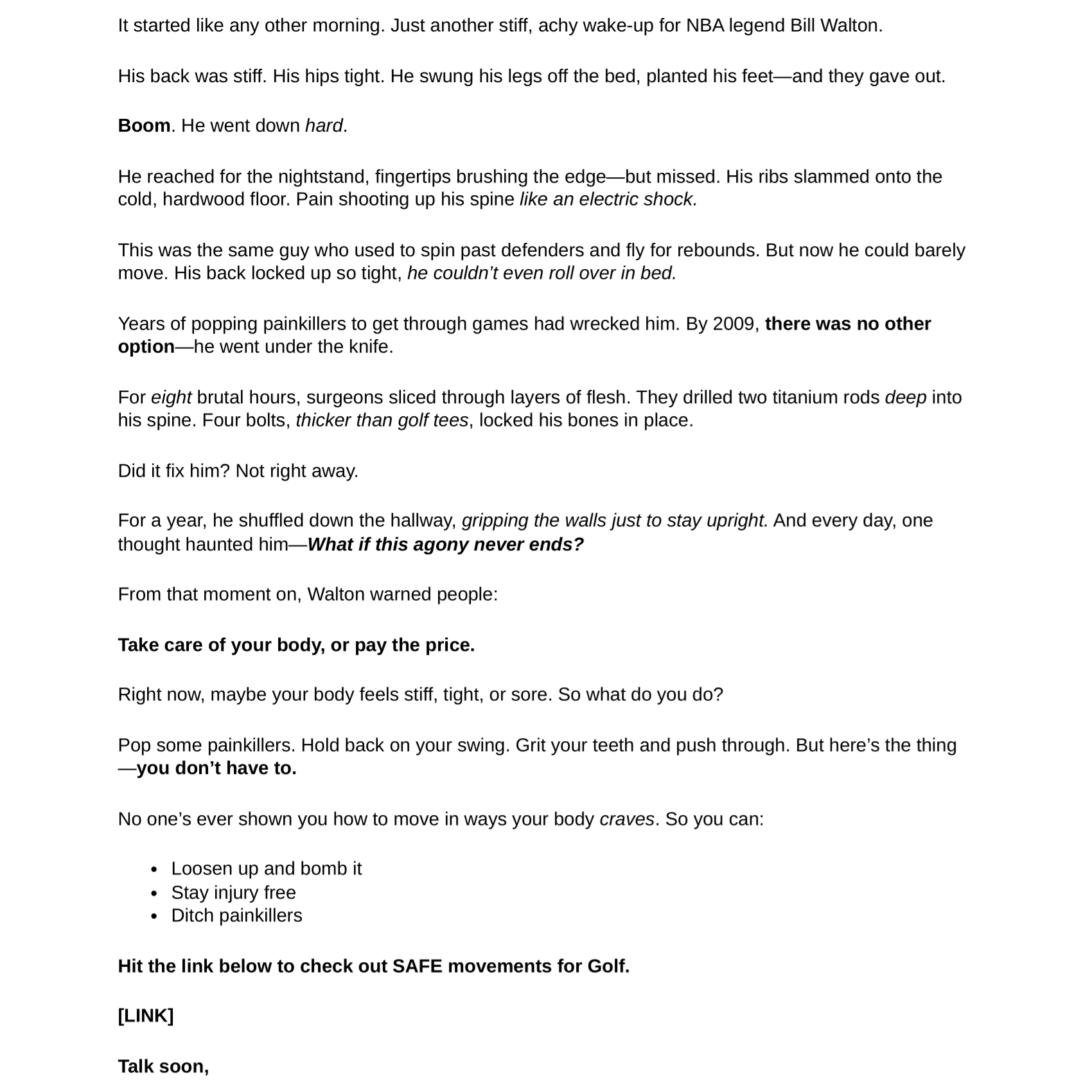
This email was an opportunity to entertain the prospects with a gripping story, whilst raising the stakes around ignoring their body's pain signals. The story tells of the physical decline of NBA legend Bill Walton. Although it's not a golf specific story, prospects will relate to Bill Walton's pain points. Here are my copy highlights:
- The subject line - "his aches got worse, then he collapsed" aimed to stop the prospect in their tracks as they ache too. It hints at serious consequences, triggering fear. I chose the visceral word "collapsed", as it hits harder than "fell". It's also short, so it's conversational and gives you the full effect in a glance (as they scroll through their inbox). Lastly, it opens a loop in the reader's mind which they can only close by opening the email.
- The hook (first 3 lines) aims to intrigue the reader. There's no pitch, no promo, just the start of a story. Also, I aimed to create instant relatability for the reader by describing the "stiff, achy wake up".
- After stating the problem, I agitate the pain using sensory verbs such as "slammed", "shooting" and "drilled". Additionally, I aimed to portray rapid escalation by going from stiff to surgery in under 200 words. This was to create fear and urgency in the prospects' minds.
- Emotional pivot and warning - I wanted to give the reader a short stark warning by saying "take care of your body, or pay the price." This aimed to put the reader at an instant crossroads, asking for action. Also, by using it as a direct quote from Bill Walton, it commands authority and doesn't come across as my client preaching.
- Transition to the reader's world - With the line "right now, maybe your body feels stiff, tight or sore. So what do you do?" I bring the focus onto the reader from the story. I then go on to talk about painkillers and pushing through, to remind them it's not sustainable.
- Appearing new or forbidden - the line "no one's shown you how to move in ways your body craves" is hinting it's something they've not seen before (unique) and implies a forbidden sense, which makes them curious to check it out.
Here's the email:
Subject Line: His aches got worse, then he collapsed
Body:
Email #2 - Painkillers Study
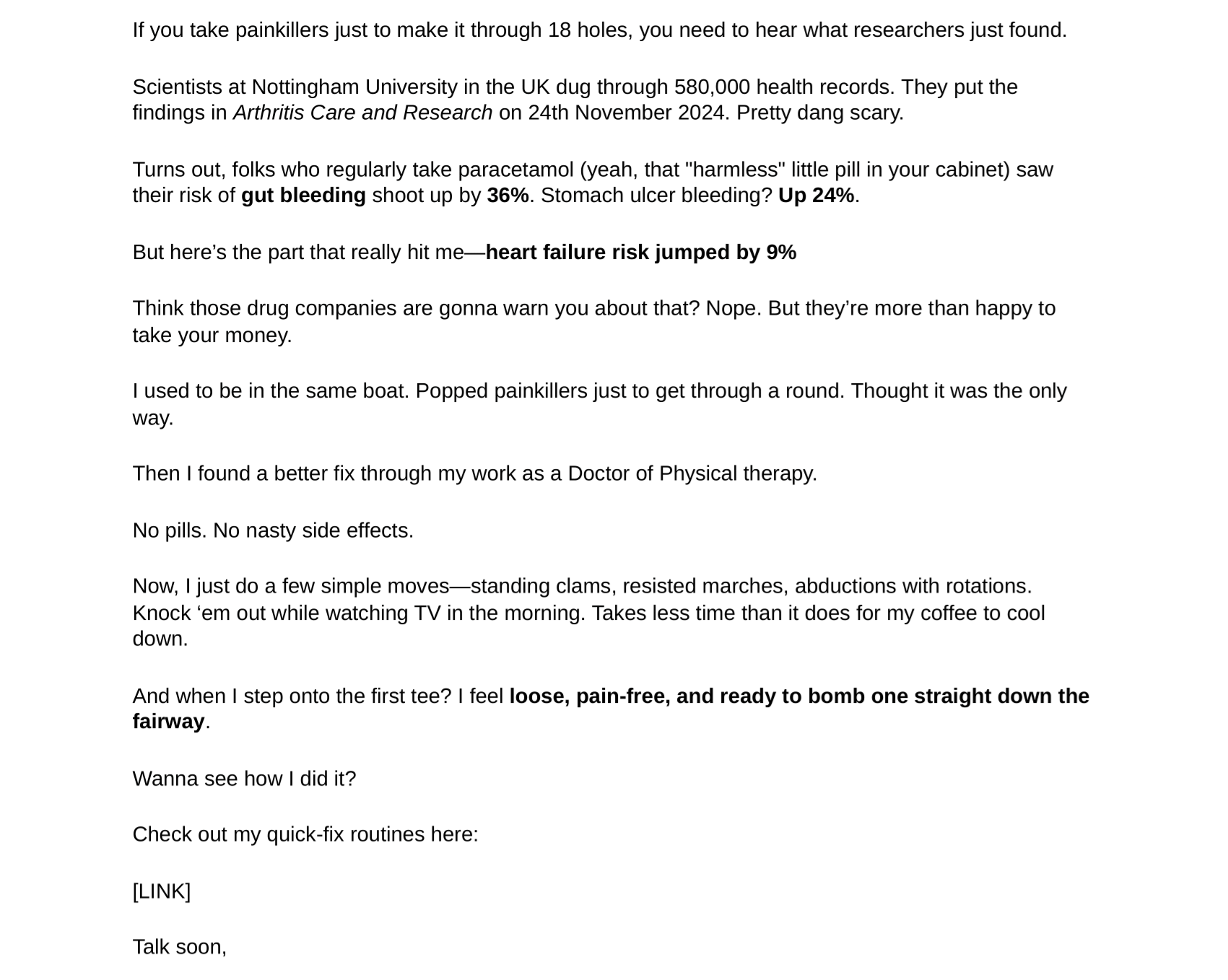
My client said lots of his customers take painkillers to get them through a round of Golf. It's my job as the copywriter to sell the prospect on a healthier way to reduce their pain (through my clients programs). Medical studies from established researchers carry authority and credibility, making them persuasive. Particularly if they're recent studies. Therefore I searched for new studies on the side effects of painkillers. And found new research suggesting harmful side effects.
Now I had an angle to create fear and put my prospects at a crossroads to take action (if they don't find a safe way to reduce their pain they're gonna get nasty side effects). Here are my copy highlights:
- Subject line - the use of "new" creates immediacy. The use of "horrors" creates a visceral effect to hit the prospect in the gut.
- Hook - "if you take painkillers just to make it through 18 holes, you need to hear what researchers just found" - this calls out the target prospect and opens a loop in their mind for them to read on.
- The use of the name of the journal and the date adds credibility and authority. This proof is backed up with "580,000" records, suggests a huge study.
- The use of "heart failure" was to instil real fear and seriousness.
- I know my client himself used to use painkillers, so I added this in to create empathy with the reader (my client has been through the same). This confession also adds a human side to my client.
- By saying the safe exercises can be done "in less time than it takes your coffee to cool" makes it doable to the prospect. This isn't hours upon hours of exercises.
Here's the email:
Subject Line: New study reveals painkiller horrors
Body:
Email #3 - Early Extension
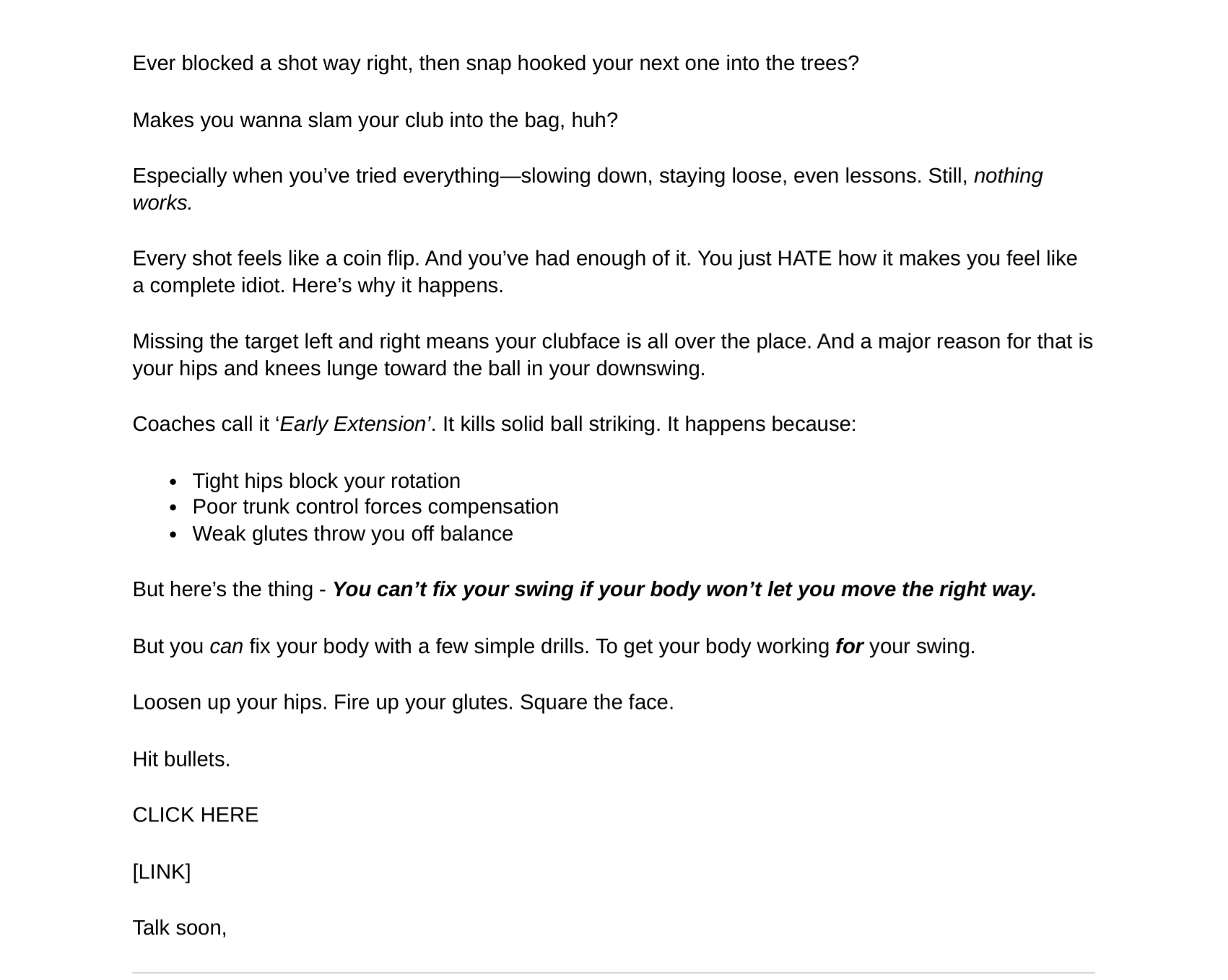
Early extension is a fault in the golf swing which causes a golfer to miss the target both right and left. Physical problems such as weak glutes, tight back muscles can make early extension worse. My client has a exercise program specifically designed to ease early extension by strengthening muscles and creating mobility. So golfers can hit straighter shots for lower scores.
My approach with this email was to create frustration and even anger about their game, to encourage them to take my clients solution. Here are my copy highlights:
- Agitating the problem and empathizing with the reader - "you've tried everything - slowing down, staying loose, even lessons". This removes blame from the reader and tells them they're not lazy. I'm validating their efforts and building trust my client has the real solution.
- Reframing the fix - "you can't fix your swing if your body won't let you move the right way". This moves the reader from blaming their swing to blaming their poor movements. It also takes away other solutions - they must fix their body (through my clients programs).
- Helplessness to hope - Having aimed the prospects to feel helpless by poking at their frustration and anger with their game, I gave them hope by saying "you can fix your body with a few simple drills".
Here's the email:
Subject Line: Sick of missing left and right?
Body:
Email #4 - Eleni Kalimnios Story
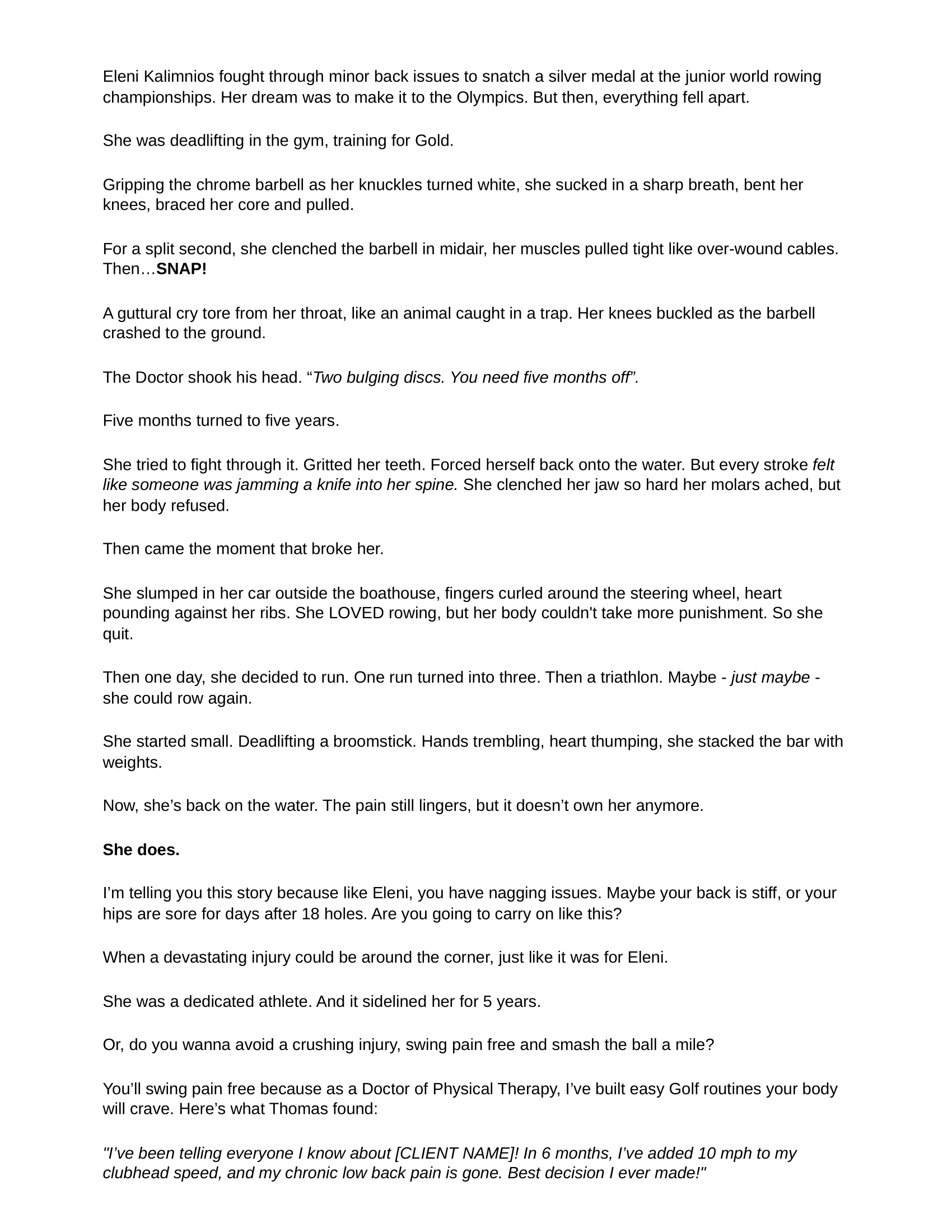
This was another storytelling email to entertain and sell. It's a resilience based email to resonate with the prospects pain points, but inspire them to take action for a brighter future. My aim was to create emotional investment before I introduced the solution. I finished the email by anchoring the price to alternatives to create irresistible value. Here are my copy highlights:
- Subject line - I wrote "nagging back pain" as it's what many of the prospects have. I'm calling them right out in the first 3 words. I used "crushed" to evoke tragedy and loss, for a strong emotional pull.
- Hook - I wanted to start in the middle of action for drama and to keep people reading. Here there's conflict which resonates to an extent with the reader. Eleni is fighting minor back pain in rowing. The prospect is fighting minor back pain in Golf. There's also something at stake - Eleni wants to make it to the Olympics.
- Making the reader feel the story - by using visceral or sensory verbs like "buckled" "crashed" "gripped" it pulls the reader into the story.
- Deepening the emotional wound - I wanted to subtly remind the prospect potential consequences of not addressing their back pain. I did this through the escalation in Eleni's story - "Five months turned to five years..every stroke felt like someone jamming a knife into her spine".
- Creating irresistible value - by anchoring my clients $24 monthly subscription to a monthly chiropractor cost of $400.
Here's the email:
Subject Line: Nagging back pain crushed Eleni's world
Body:
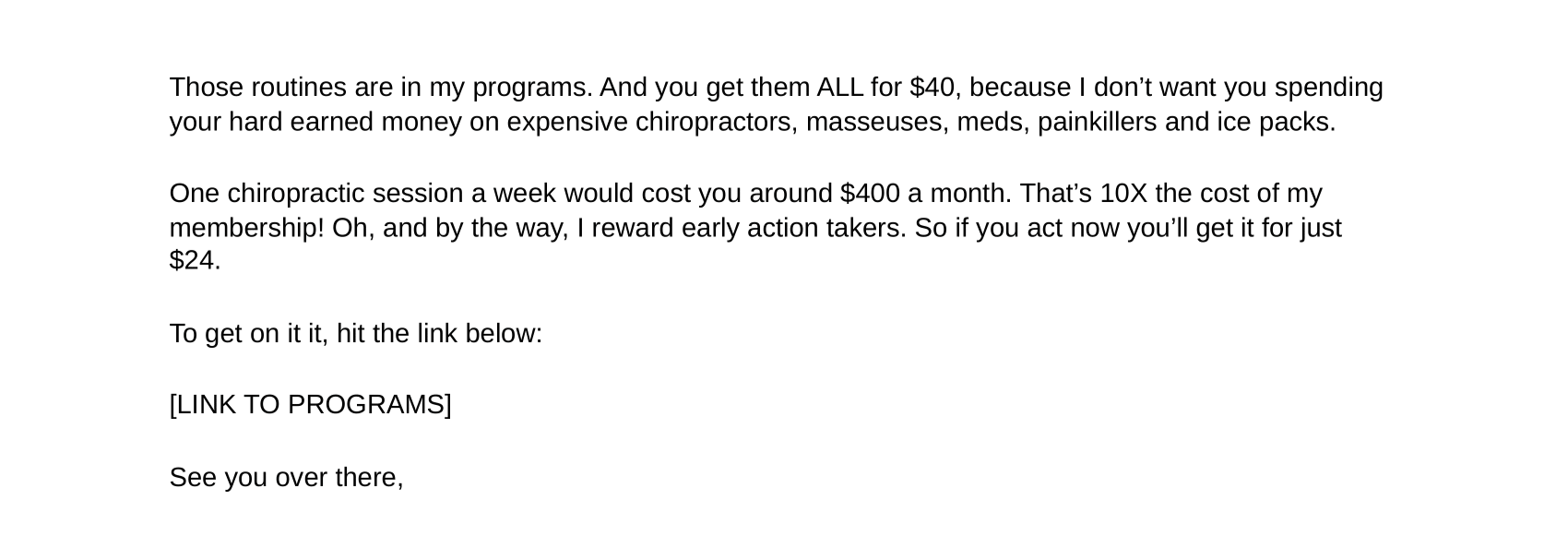
Email #5 - Low Quality Golf Fitness Advice
It came to my attention there are fitness coaches who were dishing out advice to golfers whilst having far less knowledge than my client. Therefore the angle for this email was to provoke the prospects by suggesting their nagging pain could be due to poor advice they'd received. I'd then compare this to my client who is a Doctor of Physical Therapy to position him as uniquely qualified to advise. My approach was to make the reader feel angry to motivate action. Here are my copy highlights:
- Starting with curiosity - The line "You're only hearing half the story" sparks curiosity and makes the reader feel like they're owed something. The aim is is to get them to read the entire email.
- Real quotes seen online - by using "lift for speed!" I knew it would resonate with the prospects and make them think 'what else should I do then?'
- Establishing my clients authority - By stating my client is TPI certified and a Doctor of Physical Therapy, I'm drawing big credibility contrast with these YouTube or Instagram fitness coaches.
- Reframing the fix in line with my clients USP - As a Doctor of Physical Therapy my clients knows the science of injury prevention. So I've framed the fix as this avenue, so the solution to issues clearly lies with my client.
- Irresistible offer framing - By comparing everything they get in my clients monthly subscription to one PT session, I'm creating no brainer value.
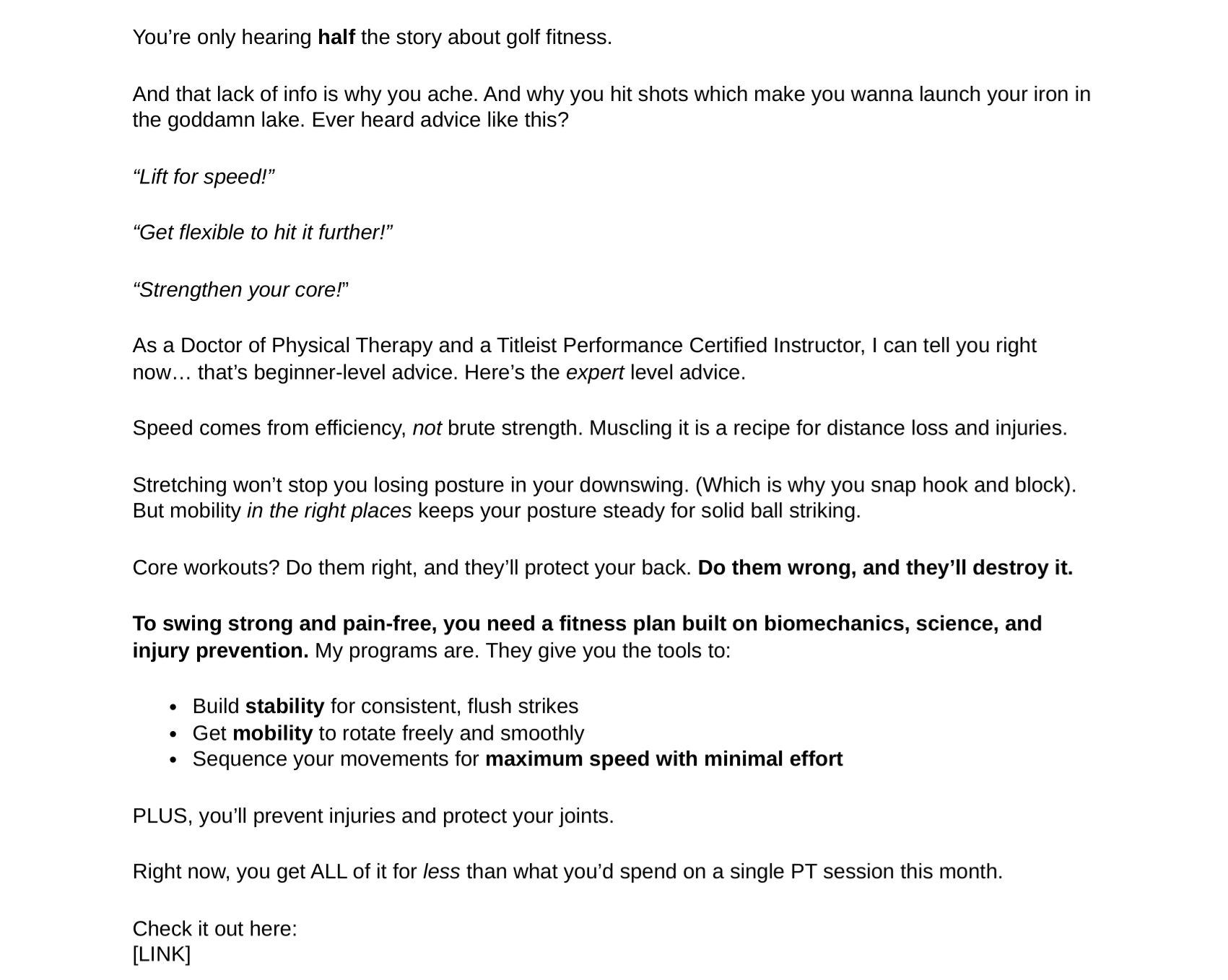
Here's the email:
Subject Line: The fitness "advice" that's actually killing your game (and your body)
Body: